

Every ingredient tells a story. But without the right tools, that story remains hidden behind grams, ounces, and ambiguous portions. For manufacturers navigating the complex landscape of nutritional product development, understanding exactly what goes into every formula isn’t just helpful—it’s essential.
A nutrition facts calculator transforms raw ingredient lists into comprehensive nutrition profiles with remarkable precision. These digital tools bridge the gap between recipe formulation and consumer transparency, converting simple measurements into detailed breakdowns of calories, macronutrients, vitamins, and minerals. For forward-thinking supplement manufacturers and nutritional product developers, these calculators serve as invaluable allies in ingredient analysis, portion planning, and strategic decision-making.
The beauty lies in simplicity. Input your ingredients and quantities, and within moments, you receive a complete nutritional snapshot. This immediate feedback empowers manufacturers to refine formulations, compare ingredient alternatives, and ensure every product meets both regulatory standards and consumer expectations. In an industry where precision matters and transparency builds trust, nutrition facts calculators have become indispensable tools for creating products that truly deliver on their promises.

Understanding How Nutrition Facts Calculators Work
The mechanics behind nutrition facts calculators reveal their powerful utility. At their core, these tools operate through straightforward input-output relationships that transform ingredient data into actionable nutritional intelligence.
Inputs begin with basic information: ingredient names, quantities measured in grams, ounces, or common units like cups and tablespoons, and sometimes preparation methods. The more precise your measurements, the more accurate your results. Many calculators accommodate both single ingredients and complete recipes, allowing manufacturers to analyze everything from individual raw materials to finished formulations.
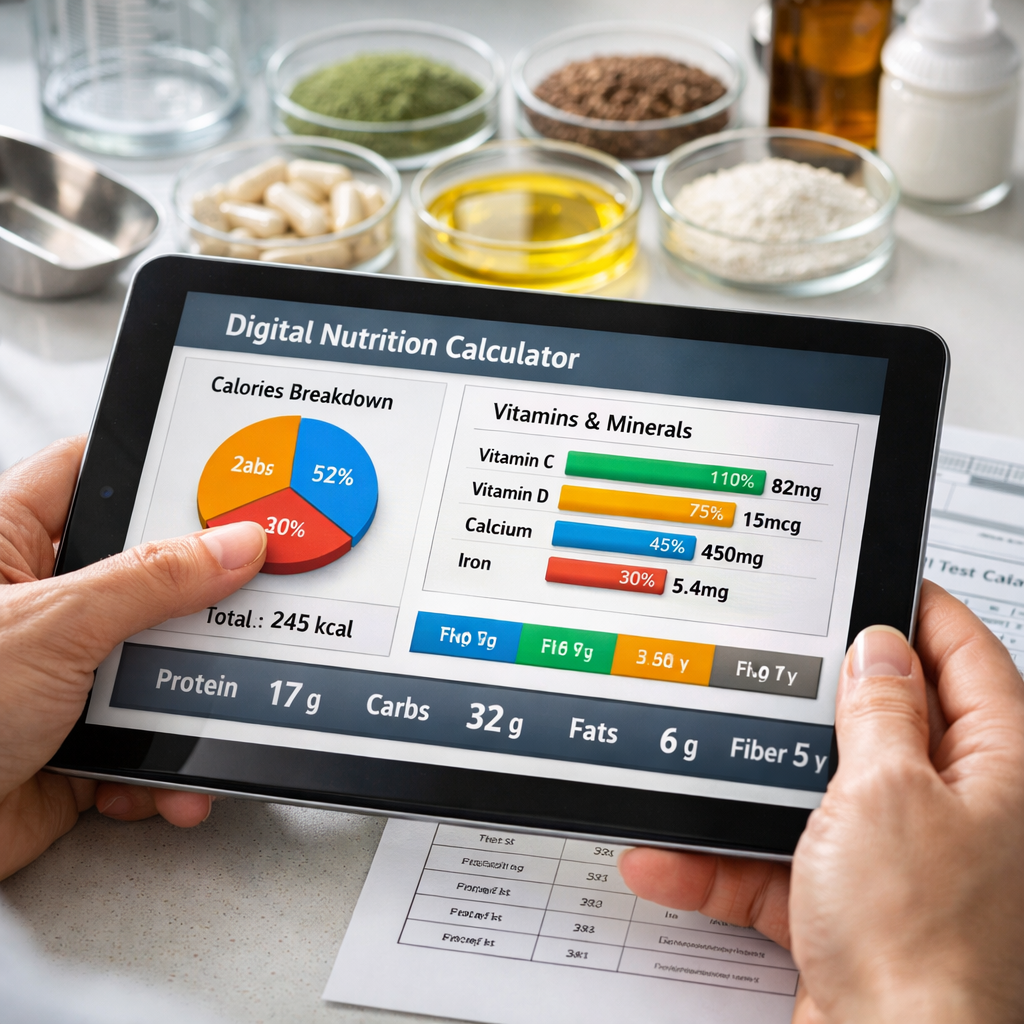
Outputs provide comprehensive nutritional breakdowns. Modern calculators generate detailed profiles including total calories, macronutrient distributions (proteins, carbohydrates, fats), dietary fiber content, and micronutrient levels spanning vitamins and minerals. These outputs help manufacturers create accurate Supplement Facts panels for regulatory compliance. With modern AI assistance, these tools achieve surprising accuracy, particularly for macronutrient breakdowns showing percentage distributions of fats, carbs, and proteins.
Data sources determine calculator reliability. The most robust tools draw from established databases like the USDA FoodData Central, which contains verified nutritional information for thousands of foods and ingredients. Some calculators supplement this foundation with proprietary research or manufacturer-specific data, creating comprehensive reference libraries that account for ingredient variations and processing effects.
The distinction between recipe analysis and single ingredient analysis matters significantly. Recipe calculators aggregate multiple ingredients, accounting for interactions and losses during preparation. Single ingredient analysis focuses on understanding raw material profiles—critical information when evaluating suppliers or comparing ingredient alternatives for formulation optimization.
Why Manufacturers Need Nutrition Facts Calculators
For enterprise businesses requiring strategic ingredient partnerships and small R&D companies developing innovative formulations, nutrition facts calculators address fundamental operational needs.
Transparency forms the foundation of consumer trust. Today’s health-conscious consumers demand clear, accurate nutritional information. Calculators enable manufacturers to provide complete transparency about what’s in their products, building credibility that translates into brand loyalty. When you can confidently state exactly what each serving delivers, you’re not just meeting regulatory requirements—you’re honoring consumer trust.
Comparison capabilities streamline ingredient sourcing decisions. Need to evaluate whether Magnesium Oxide or Magnesium Citrate better serves your formulation goals? A nutrition facts calculator reveals precise differences in bioavailability, concentration, and nutritional impact. This comparative power extends across all ingredient categories, from amino acid series components to vitamin complexes, enabling data-driven choices that balance cost, efficacy, and consumer appeal.
Dietary adherence validation ensures products meet specific nutritional criteria. Whether formulating for keto-friendly supplements, vegan protein products, or low-sodium health solutions, calculators verify that finished products align with dietary standards and RDA requirements. This verification proves essential when targeting specific consumer segments or meeting certification requirements.
Allergen awareness and sensitivity considerations protect consumers and brands alike. Advanced calculators flag potential allergens and cross-contamination risks, helping manufacturers maintain rigorous safety standards while documenting due diligence for regulatory compliance.
Product development acceleration represents perhaps the most valuable benefit. Rather than waiting days for lab analysis during iterative formulation, nutrition facts calculators provide immediate feedback. Test ingredient substitutions, adjust ratios, optimize serving sizes—all within minutes rather than weeks. This rapid iteration capability compresses development timelines and reduces costs associated with physical prototyping.
Practical applications span the product lifecycle. During meal planning phases, R&D teams use recipe calorie calculators to model complete nutritional profiles before committing to ingredient purchases. When preparing nutrition panels for packaging, these tools generate the precise data required for FDA-compliant labels. Fitness and sports nutrition brands validate claims about protein content, amino acid profiles, or energy delivery, ensuring marketing messages align with measurable reality.
Best Practices for Accurate Calculations
Precision in nutritional analysis demands attention to methodological details that significantly impact results.
Accurate ingredient measurement cannot be overstated. Digital scales measuring to 0.1-gram precision should replace volume measurements whenever possible. While “one cup” provides convenience, ingredient density variations introduce substantial error margins. For manufacturers, where consistency across production batches matters critically, weight-based measurements ensure reproducibility.
Raw versus cooked states present a common calculation pitfall. Many ingredients undergo dramatic nutritional changes during preparation. Proteins denature, water content shifts, and some nutrients degrade under heat. Always specify the ingredient state matching your actual formulation. If you’re working with dried herbs versus fresh, or roasted nuts versus raw, these distinctions affect final nutritional profiles by percentages significant enough to impact label accuracy.
Database limitations require acknowledgment and adaptation. No single database captures every ingredient variation, processing method, or supplier-specific formulation. When working with proprietary blends, novel ingredients, or specialized sources like NutraAeon’s high-purity amino acids, supplement calculator data with manufacturer certificates of analysis. This hybrid approach combines the convenience of automated calculations with the precision of verified supplier specifications.
Verification through multiple tools provides confidence in labeling accuracy. Cross-reference results across two or three reputable calculators. Discrepancies often reveal data gaps or calculation methodology differences worth investigating before finalizing nutrition panels. For critical product launches or regulatory submissions, consider investing in professional laboratory analysis to validate calculator estimates—a worthwhile quality assurance step that protects both consumers and brand reputation.
Documentation practices support long-term quality control. Maintain detailed records of which calculator versions, databases, and ingredient specifications generated each nutritional profile. When reformulating or investigating batch variations, this documentation enables precise replication and troubleshooting.
Evaluating Calculator Tools for Your Needs
Not all nutrition facts calculators serve manufacturers equally. Strategic tool selection requires evaluating several critical features.
Nutrient database breadth determines coverage and relevance. The best calculators access comprehensive databases encompassing thousands of foods, ingredients, and supplements. Look for tools incorporating USDA-approved nutrient analysis standards while also including specialized supplement ingredients. Databases exclusively focused on whole foods may lack data for concentrated extracts, amino acids, or fortification compounds essential to nutritional manufacturing.
Custom ingredient handling separates basic consumer tools from professional-grade calculators. Can you input proprietary ingredients with custom nutritional profiles? This capability proves essential when working with specialized suppliers or novel ingredients not yet cataloged in standard databases. Advanced tools allow you to build personal ingredient libraries incorporating supplier-specific data, certificates of analysis, and your own testing results.
Unit flexibility accommodates diverse workflow preferences. Professional calculators seamlessly convert between metric and imperial measurements, handle percentage-based formulations, and support batch scaling. The ability to calculate nutrition facts for 100-gram reference servings, single-dose capsules, or production runs of thousands of units streamlines operations across R&D, quality control, and production planning.
Privacy considerations matter when working with proprietary formulations. Cloud-based calculators offer convenience but may raise concerns about intellectual property protection. Evaluate whether tools store recipe data, how they protect sensitive information, and whether offline operation modes exist for confidential projects. Some manufacturers prefer downloadable software or internal tools that keep formulation details entirely in-house.
Transparency about assumptions and calculations builds confidence in results. Quality calculators disclose their data sources, explain calculation methodologies, and acknowledge limitations. Watch for tools that provide references to scientific literature, specify database versions, and clearly communicate when estimations supplement verified data. This transparency enables informed interpretation of results rather than blind reliance on black-box outputs.
Additional features worth considering include multi-currency ingredient costing, allergen flagging systems, regulatory compliance checkers for different markets, and integration capabilities with formulation management software or ERP systems.
Understanding Limitations and Caveats
Even the most sophisticated nutrition facts calculators operate within inherent constraints that manufacturers must understand.
Data variability reflects real-world ingredient inconsistencies. Two batches of L-Theanine from different suppliers may exhibit minor compositional differences. Agricultural products like vitamin-rich botanicals vary by growing conditions, harvest timing, and storage. Calculators typically use average values that may not perfectly match your specific ingredient lots. This reality underscores the importance of working with reliable suppliers who provide detailed certificates of analysis for each batch.
Complex recipe challenges can exceed calculator capabilities. Multi-step preparation processes, fermentation, extended cooking, or specialized extraction methods may alter nutritional profiles in ways standard calculators cannot model. When developing products involving enzymatic reactions, bioavailability enhancements, or delayed-release mechanisms, calculator estimates provide starting points requiring validation through laboratory analysis.
Missing nutrients represent gaps in even comprehensive databases. Emerging phytonutrients, novel bioactive compounds, or newly identified micronutrients may lack sufficient research data for inclusion in calculator databases. If your formulation specifically targets less-common nutritional components, expect to supplement calculator outputs with specialized research and testing.
Bioavailability factors remain largely unaddressed by standard calculators. The nutritional content of ingredients doesn’t always translate directly to nutritional benefits for consumers. Certain forms of minerals absorb more efficiently than others—food-grade Magnesium Oxide offers different bioavailability than Magnesium Glycinate, for instance. Calculators report elemental content but rarely account for these absorption differences that significantly impact real-world efficacy.
Realistic expectations guide appropriate calculator use. These tools excel at providing rapid estimates and comparative analyses during development. They help identify formulation directions, flag potential issues, and generate draft nutrition panels. However, they shouldn’t replace professional laboratory analysis for final product verification, regulatory submissions, or resolving quality control questions. View calculators as powerful assistants that inform but don’t replace comprehensive testing protocols.
Communicating Nutrition Insights Effectively
For manufacturers building brands through digital channels, translating calculator outputs into compelling consumer communications requires strategic thinking.
Serving size clarity prevents confusion and builds trust. When sharing nutritional information, always specify exactly what constitutes one serving. “Per capsule,” “per scoop,” or “per recommended daily dose” provides context consumers need for meaningful interpretation. Include visual references when possible—showing a capsule next to common objects helps consumers visualize portion sizes without technical jargon.
Visual aids transform raw data into accessible insights. Infographics showing macronutrient distributions, charts comparing your product’s vitamin content to daily value percentages, or simple icons highlighting key nutritional strengths communicate faster than text-heavy panels. Social media audiences particularly appreciate visual summaries that convey essential information at a glance.
Tool citations demonstrate methodological rigor while educating audiences. Mentioning that nutritional calculations utilize evidence-based nutrition standards or specify calculator names adds credibility to your claims. This transparency also manages expectations—acknowledging that values represent calculations rather than lab-tested guarantees for each individual unit shows professional honesty consumers appreciate.
Accessible language makes nutrition science approachable. Not everyone understands what “20% DV” means or why amino acid profiles matter. Translate technical nutritional data into benefit-focused language. Instead of “Contains 200mg L-Theanine,” try “Delivers research-supported doses of L-Theanine for promoting calm focus.” Connect nutritional facts to tangible wellness outcomes consumers care about.
Context provision helps consumers interpret numbers meaningfully. Sharing that your Vitamin C content “equals three oranges” or protein levels “match a chicken breast” creates relatable comparisons. Contextualize mineral content against common deficiency statistics, explaining why certain nutrient levels matter for specific demographics or lifestyle needs.
Effective communication balances technical accuracy with human connection. Your nutrition facts calculator provides the data foundation; your messaging transforms that foundation into compelling stories that resonate with health-conscious consumers seeking products they can trust.
Key Takeaways for Smarter Manufacturing
Nutrition facts calculators represent more than convenient tools—they embody a philosophy of informed decision-making that aligns perfectly with quality-focused manufacturing practices.
These calculators turn ingredient lists into actionable insights, revealing exactly what each formulation delivers. For manufacturers committed to excellence, this transparency isn’t optional—it’s foundational. Understanding precisely what goes into every product enables optimization across quality, cost, and efficacy dimensions simultaneously.
The best nutrition facts calculators promote systematic transparency throughout product development. They encourage rigorous documentation, facilitate data-driven comparisons, and support iterative refinement toward formulation perfection. When manufacturers embrace these tools as integral to quality assurance rather than mere label compliance aids, they unlock competitive advantages through superior product knowledge.
Supporting dietary goals extends beyond consumer markets into B2B relationships. When you can demonstrate precise nutritional profiles backed by calculator analysis and certificate verification, you strengthen partnerships with distributors, retailers, and co-manufacturing clients who value supplier transparency and technical competence. This approach aligns with NutraAeon’s commitment to quality sourcing for supplement manufacturers.
Remember that calculators provide informed guidance rather than perfect measures. Use them wisely as components within comprehensive quality systems that also include supplier verification, laboratory testing, and continuous improvement protocols. The manufacturers who thrive balance technological tools with human expertise, data analysis with relationship building, and efficiency with thoroughness.
In an industry where ingredients matter profoundly and transparency builds lasting value, nutrition facts calculators serve as essential partners in your commitment to excellence. They help ensure every formulation decision aligns with your quality standards, your customer promises, and your vision for products that genuinely improve lives. Master these tools, understand their limitations, and leverage their insights—this combination distinguishes manufacturers who merely comply from those who consistently excel.