A mid-sized sports nutrition brand — one with solid sales, loyal customers, and a growing retail presence — got a call from their contract manufacturer last spring. A batch of their best-selling amino acid blend had failed a routine third-party audit. The culprit? A raw ingredient that looked perfectly fine on paper. The supplier’s COA showed everything in spec. But an independent lab found heavy metal contamination well above FDA action levels.
The brand pulled the product. Notified retailers. Issued a voluntary recall. Lost roughly $400,000 in the process — not counting the brand damage that took 18 months to repair.
This is not a rare story. It plays out across the supplement industry every year, in different forms, with different ingredients and different brands. And in almost every case, someone made at least one of five very common mistakes when selecting or using dietary supplement testing services. Let’s go through each one. If you’re still getting familiar with how nutraceutical manufacturing quality gaps can sink a brand before launch, that’s a useful starting point.

Mistake #1: Treating Supplier COAs as a Substitute for Independent Testing
The Certificate of Analysis is the supplement industry’s most widely trusted document — and its most widely abused one.
A COA looks authoritative. It lists specifications, test results, and a lab signature. Many brands receive them from suppliers and file them away, confident the ingredient has been verified. But here’s what most people don’t say out loud: a COA is only as trustworthy as the lab that ran the tests. And not all labs are equal.
In a 2023 analysis published in JAMA Network Open, researchers found that a significant percentage of supplements sold in the US contained ingredients not listed on the label — or at different concentrations than stated. Most of those products had COAs on file. The documentation existed. The quality did not.
Fake or manipulated COAs are not hypothetical. They circulate in global ingredient supply chains more frequently than the industry admits. Some are outright fabrications. Others are legitimate documents from one batch being reused on different, untested shipments.
The only real protection is independent third-party testing — specifically, testing performed by a lab with no relationship to your supplier and no financial stake in the result. This doesn’t mean you need to test every single incoming shipment for everything. But a risk-based incoming inspection program, with verified third-party testing for your highest-risk ingredients, is non-negotiable if you’re serious about dietary supplement testing services.
Mistake #2: Choosing a Testing Lab Based on Price
Budget pressure is real in supplement manufacturing. When you’re trying to keep COGS down, every line item matters. So when one testing lab quotes $300 per sample and another quotes $900, the cheaper option looks like an obvious win.
It usually isn’t.
The single most important credential a dietary supplement testing lab can have is ISO/IEC 17025 accreditation. This international standard confirms that the lab has demonstrated technical competence in its testing methods, maintains proper equipment calibration, and operates under a quality management system subject to ongoing external audit. Without it, there’s no reliable way to verify that the lab’s results are accurate or reproducible.
Beyond ISO 17025, consider whether the lab has specific experience with your ingredient types. A lab that specializes in botanical extracts uses different analytical methods than one focused on amino acids or synthetic vitamins. Method validation matters enormously. A lab that hasn’t validated its methods for your specific matrix may give you results that look clean simply because its detection limits aren’t sensitive enough.
Then there’s turnaround time. Some budget labs take three to four weeks for routine panels. If you’re trying to maintain production schedules or respond to a market opportunity, that delay is a real cost — one that often dwarfs the savings on the testing fee itself.
When evaluating dietary supplement testing services, ask for the lab’s accreditation certificates, scope of accreditation (which specific methods are covered), and examples of reports in your product category. A reputable lab will provide all of this without hesitation.
Mistake #3: Testing Finished Products but Skipping Raw Material Inspection
Here’s a scenario that frustrates quality managers across the industry: a brand runs extensive finished-product testing. Every batch gets a full panel — potency, identity, microbials, heavy metals. Results come back clean, every time. Then a retail audit catches a problem with one SKU. The source turns out to be a contaminated raw ingredient that passed through multiple production runs before anyone caught it.
How does that happen?
Finished-product testing can mask ingredient-level problems. When you blend multiple ingredients together and then test the finished capsule or powder, the analytical sensitivity for any single component drops. Contaminants can dilute below detection thresholds. Potency issues can be partially offset by other ingredients. The finished product looks fine. The underlying problem remains.
Raw material testing — testing each ingredient before it enters your production process — is where quality control actually lives. This is why FDA’s current Good Manufacturing Practices (cGMP) regulations, codified in 21 CFR Part 111, require identity testing for every raw ingredient, every time. Not just once per supplier, not just for new ingredients. Every time.
A solid raw material program includes at minimum: identity confirmation (to verify you have what you ordered), potency/assay testing (to confirm concentration), and targeted contaminant screening based on the ingredient’s known risk profile. Amino acids sourced from China, for example, should be screened for heavy metals and specific process-related impurities. Botanicals need pesticide and mycotoxin panels.
Skipping raw material testing and relying solely on finished-product testing is like only checking your car’s oil at the gas station after the engine light comes on. By then, the damage is done.
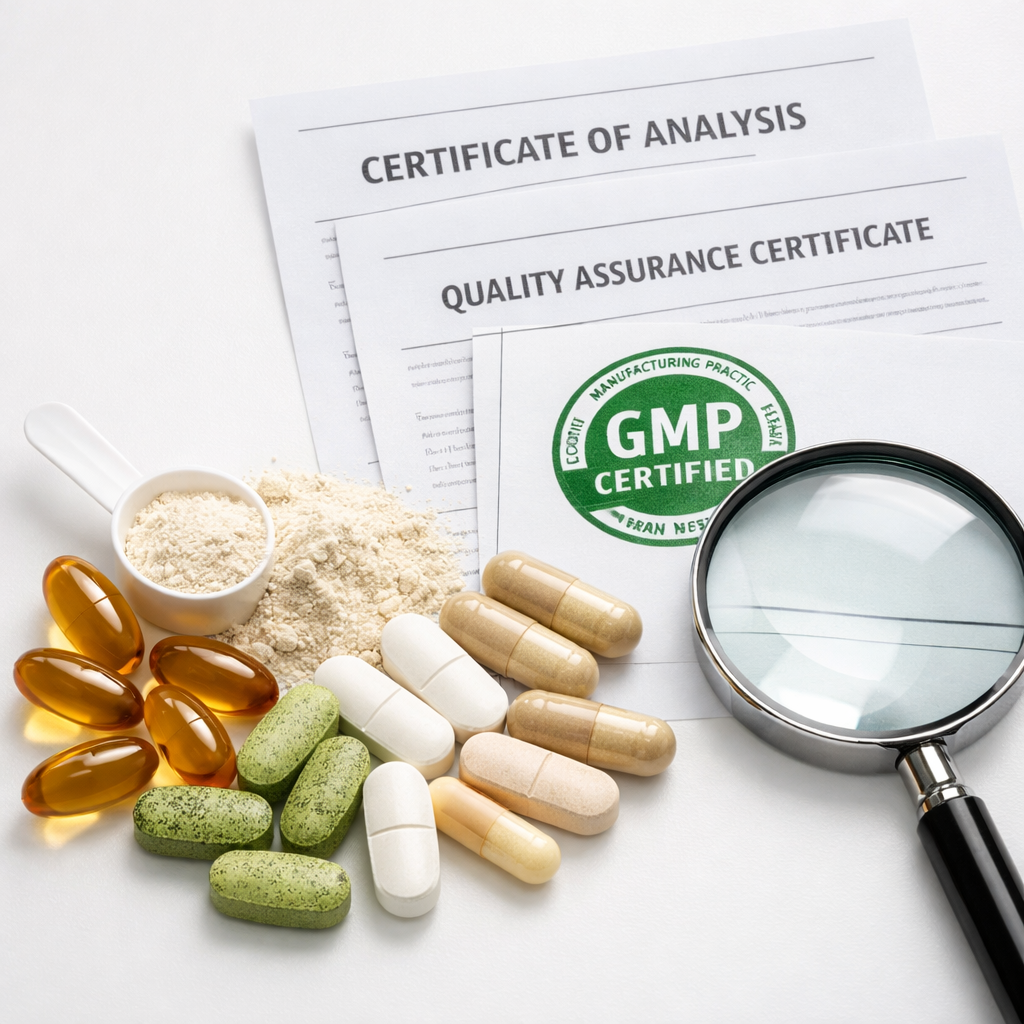
Mistake #4: Not Knowing Which Tests to Order
Walk into a conversation with a testing lab unprepared and you’ll end up with one of two outcomes: you’ll order a generic panel that misses your actual risk points, or you’ll get upsold into an exhaustive battery of tests that costs three times what you need to spend.
Understanding what tests exist — and why — is fundamental to running an effective dietary supplement testing program.
Identity testing confirms that an ingredient is what the label says it is. For amino acids, this typically involves HPLC or mass spectrometry. For botanicals, DNA barcoding or chromatographic fingerprinting. Identity is your first line of defense against substitution fraud — a surprisingly common problem, especially with expensive ingredients.
Potency/assay testing verifies that the active component is present at the claimed concentration. An L-Theanine ingredient specified at 99% purity should test at or above that threshold. Under-potent ingredients mean under-dosed products — your customers aren’t getting what they paid for, and you’re in FDA violation territory.
Purity and contaminant testing is where the real complexity lives. The major categories:
- Heavy metals (lead, arsenic, mercury, cadmium) — critical for any ingredient with botanical origin or manufactured in regions with industrial contamination risk
- Microbial testing (total aerobic count, yeast and mold, pathogens like Salmonella and E. coli) — required for any ingredient that could support microbial growth
- Pesticide residues — especially relevant for plant-derived ingredients
- Residual solvents — for any ingredient that undergoes solvent extraction during processing
- Mycotoxins — for grain-derived or botanical ingredients
The right testing panel for a synthetic amino acid manufactured under GMP conditions looks very different from the right panel for a herbal extract sourced from contract farms. Knowing the risk profile of your ingredient — its origin, its manufacturing process, its known adulterants — is what determines which tests actually matter.
Working with an ingredient supplier that provides full specification sheets, manufacturing documentation, and historical testing data makes this process dramatically easier. It’s one of the clearest advantages of sourcing from a verified partner over buying from the lowest-bid spot market. For brands exploring private label supplement sourcing strategies, ingredient transparency is often the difference between a smooth launch and a costly setback.
Mistake #5: Treating Testing as a One-Time Box to Check
This is the most dangerous mistake, because it masquerades as a responsible practice.
A brand qualifies a new ingredient supplier. They do a thorough audit — visit the facility, review certifications, run a full battery of tests on the first three shipments. Everything passes. The supplier gets approved. And then, for the next 24 months, incoming shipments get waved through with a quick visual inspection and a COA review.
This is how product quality erodes silently. Supply chains are not static. A manufacturer can change a raw material source. A production team can cut a corner under cost pressure. A crop harvest can introduce new contaminants. None of these changes come with an announcement.
The supplement industry’s recall history tells this story repeatedly. In 2024 alone, the FDA issued dozens of recall notices related to dietary supplements — undeclared allergens, potency failures, contamination issues. A large portion of these involved products that had previously tested clean.
A sustainable testing strategy treats dietary supplement testing services as a continuous system, not a one-time qualification event. This means:
- Periodic re-qualification of approved suppliers (at minimum annually)
- Skip-lot or frequency-based testing of incoming raw materials, not just initial qualification batches
- Triggered testing protocols when supply chain conditions change (new sub-supplier, production site change, price anomalies that suggest ingredient substitution)
- Documented COA review procedures that include verification against expected ranges, not just acceptance at face value
Building these systems is not as expensive or complex as it sounds. What it requires is intention — treating quality assurance as an operational priority rather than a compliance afterthought.
Building a Smarter Testing Strategy
The five mistakes above aren’t made by irresponsible brands. They’re made by busy ones — teams managing formulation, manufacturing, sales, and regulatory simultaneously, trying to move fast without dropping the ball on quality.
The practical antidote has two parts.
First, build a risk-tiered testing program. Not every ingredient needs the same testing intensity. High-risk ingredients — those from novel sources, those with known adulteration histories, those used in large quantities with significant potency implications — get the full panel every time. Lower-risk, well-characterized ingredients from long-qualified suppliers can be managed with lighter touch programs and periodic re-qualification.
Second, start upstream. The easiest way to reduce testing burden and increase confidence in your results is to source from suppliers who have already done serious quality work. Verified GMP-certified manufacturers, suppliers who provide full documentation packages, partners who can trace ingredient lots back through their supply chain — these partners make your testing program more efficient because they’ve already eliminated a significant portion of the risk. Exploring what manufacturing standards actually separate premium from mediocre supplements is a good framework to start with.
At NutraAeon, every ingredient in our network comes from factories that are GMP, ISO, or HACCP certified. We provide full documentation: specification sheets, Certificates of Analysis from accredited labs, and traceability back to the manufacturing source. Our team has 30+ years of supply chain experience across the Chinese ingredient industry — which means we’ve seen the problems that aren’t in the textbooks, and we’ve built our sourcing practices around avoiding them.
The supplement industry is built on trust — consumer trust, retailer trust, regulatory trust. Dietary supplement testing services are the infrastructure that makes that trust possible. Get the testing right, and everything else becomes easier. Get it wrong, and no amount of great formulation or marketing will save you when something goes sideways. Ready to connect with a verified ingredient partner who’s already done the quality groundwork? That’s where the conversation starts.