A purchasing director at a mid-sized sports nutrition brand once told me she spent six months evaluating a Chinese amino acid supplier — only to discover on the first production run that their Certificate of Analysis was issued by an in-house lab with zero third-party oversight. Six months of development investment and a product launch delay, all traced back to one missed step in the qualification process.
She’s not alone. This exact scenario plays out across North American supplement manufacturing every year, because nutraceutical ingredient sourcing is one of those disciplines that looks deceptively simple on paper and turns brutally complex in execution.
This guide is for B2B buyers who already know the basics — and want the strategic framework that actually protects their supply chain, their compliance posture, and their margins.
Why Most Sourcing Strategies Break at the Supplier Qualification Stage
The nutraceutical market is on a strong growth trajectory. Grand View Research pegs the global nutraceuticals market at over $454 billion in 2023, with compound annual growth consistently above 7%. With that growth comes an explosion in the number of suppliers claiming GMP certification, third-party testing, and full regulatory documentation.
The problem: not all of those claims hold up.
According to the Natural Products Association, a significant percentage of FDA warning letters issued to supplement manufacturers cite raw material identity or purity failures — issues that trace directly back to inadequate supplier qualification. The FDA’s 21 CFR Part 111 places the burden squarely on the manufacturer: you are responsible for verifying that every ingredient meets specifications before it enters production.
“The industry has a chronic problem with what I call ‘certificate theater’ — suppliers presenting documentation that looks authoritative but hasn’t been independently verified. Buyers who skip the audit step are essentially betting their entire product line on a piece of paper.” — Dr. Sarah Mitchell, Regulatory Affairs Consultant, Natural Products Industry Association
 $’\n\n’
Real supplier qualification goes well beyond requesting a COA. It requires a systematic framework covering four dimensions: documentation integrity, facility standards, testing methodology, and supply chain traceability.
The Four-Layer Qualification Framework
Experienced procurement teams at established supplement brands don’t evaluate suppliers with a checklist — they use a layered qualification model that distinguishes between table-stakes requirements and genuine differentiators.
Layer 1: Documentation Baseline
Before any conversation about price or MOQ, every qualified supplier should provide — unprompted — a current Certificate of Analysis from a third-party accredited laboratory, specification sheets with defined parameters (not just “meets specifications”), and relevant certifications: GMP, ISO 9001, HACCP, and where applicable, Kosher or Halal documentation. The baseline check is whether these documents are current (within 12 months), issued by a named third-party lab, and specific to the exact product batch and grade you’re evaluating.
Layer 2: Facility Verification
There is no substitute for a facility audit. Remote video audits became standard practice during COVID and remain acceptable for initial qualification, but on-site audits — or third-party audit reports from recognized bodies like NSF International, Bureau Veritas, or SGS — provide a much deeper picture. Understanding what GMP certification actually requires helps you evaluate what auditors look for. You’re looking at manufacturing environment controls, equipment calibration records, batch traceability systems, and how they handle non-conforming materials.
Layer 3: Testing Methodology Transparency
Ask specifically: which test methods do you use for identity confirmation? HPLC, ICP-MS for heavy metals, microbiological testing — the standard is set by USP and NSF per federal cGMP regulations. Suppliers who can’t name specific methods or reference pharmacopeial standards are a yellow flag. Better suppliers will offer third-party retesting upon request and maintain reference standards for comparison.
Layer 4: Supply Chain Traceability
For botanical and fermentation-derived ingredients especially, you need to understand the full upstream chain. Where is the raw material grown or processed? At what point does the material enter the supplier’s custody? Emerging blockchain-based traceability systems are making this easier, but direct upstream documentation from the manufacturer remains the gold standard for most buyers today.
The China Sourcing Equation: Risk, Reward, and How to Navigate Both
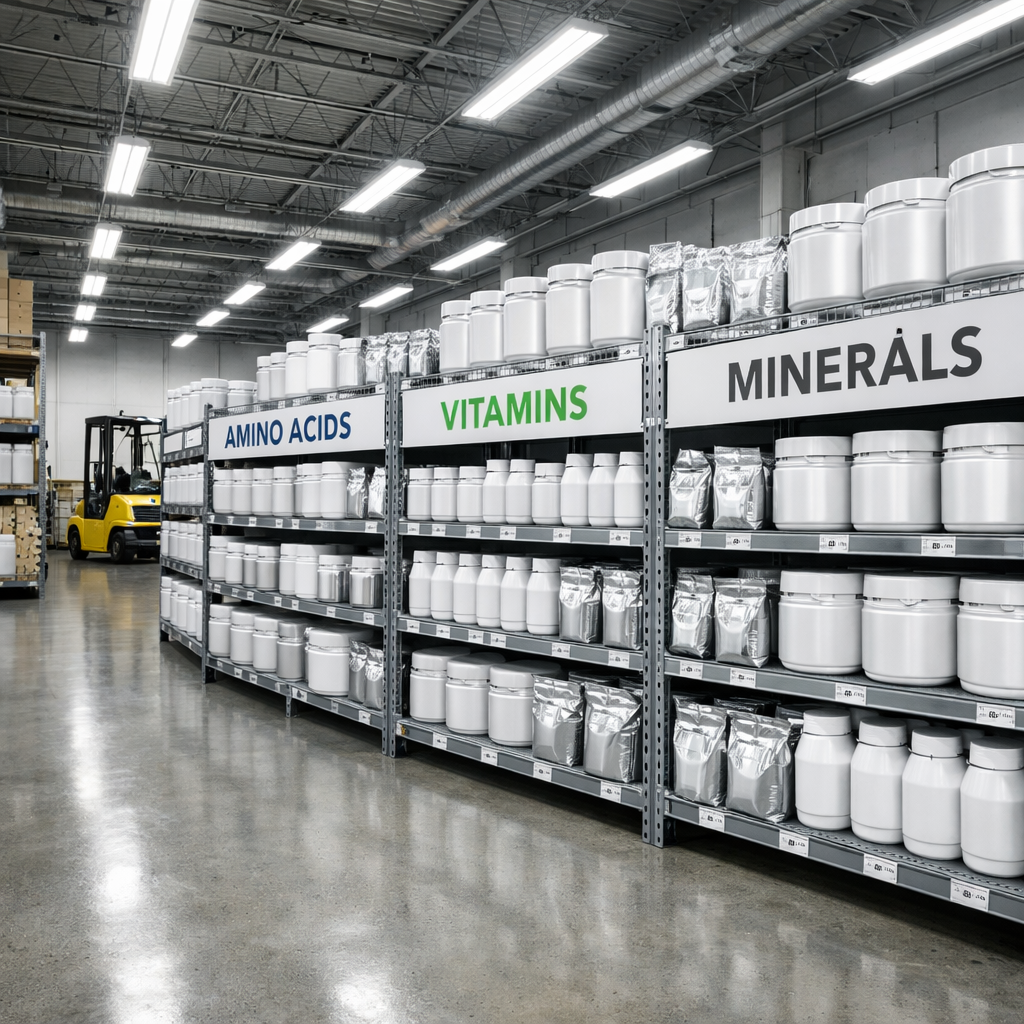
China remains the dominant global source for amino acids, vitamins, minerals, and a growing range of functional ingredients. For context: China produces approximately 80% of the world’s vitamin C supply, and for amino acids like L-Theanine and L-Tryptophan, Chinese manufacturers represent the majority of global production capacity.
The risk-reward calculation is real. Procurement from Chinese manufacturers can deliver 30-50% cost advantages over US-based distributors for the same specification ingredient. But those savings evaporate instantly if you receive adulterated material, face an FDA action, or have to scrap a production batch due to contamination.
The buyers who navigate this successfully aren’t avoiding China — they’re building the right verification infrastructure around it. That means:
- Requiring independent third-party retesting at a US-based accredited laboratory before material enters your facility
- Sourcing through verified intermediaries with established manufacturer relationships, rather than directly from directory listings
- Starting with smaller qualification batches before committing to volume orders
- Establishing a dual-sourcing model — at least two qualified suppliers for any critical ingredient — to protect against disruption
The 2020-2021 pandemic supply chain disruptions were a painful reminder of concentration risk. Brands with single-source dependence on any ingredient faced months-long stockouts. The brands that maintained business continuity almost universally had dual-source or warehoused inventory strategies in place.
 $’\n\n’
MOQ Reality: Why Small Brands Get Squeezed and What to Do About It
One of the most persistent friction points in nutraceutical ingredient sourcing is minimum order quantity. Most Chinese manufacturers operate with MOQs starting at 500kg to 1 metric ton for standard ingredients — a reality that effectively locks out startups, R&D-phase companies, and brands launching new SKUs.
This creates a problematic downstream effect. Buyers who can’t meet factory MOQs either turn to US distributors (paying a significant markup for the same material) or — more dangerously — to unverified spot-market sources with no established quality track record.
The structural solution is access to a sourcing partner with US-based warehousing and smaller batch availability. This model allows manufacturers to access 25kg, 50kg, or 100kg quantities of verified ingredients without the cost penalty of domestic distributor markups. For product development phases specifically, this capability dramatically reduces the capital at risk during formulation and clinical testing stages.
A practical evaluation criterion: when assessing a sourcing partner’s US warehouse capability, ask specifically about turnover rates and lot tracking. A warehouse that moves high volumes maintains ingredient freshness and provides genuine lot-specific documentation — not a warehouse that’s simply holding aged inventory repackaged under new lot numbers.
Building a Resilient Sourcing Strategy: The Operational Checklist
Beyond supplier qualification, a complete nutraceutical sourcing strategy addresses several operational dimensions that procurement teams often underinvest in.
Regulatory Documentation Management
Every ingredient in your supply chain needs a maintained documentation file: COA, spec sheet, allergen declaration, heavy metals testing, microbiological testing, and for imported materials, country of origin documentation. This is the evidence package you’ll need if the FDA inspects your facility or if you need to respond to a customer or retailer audit. The time to build this package is before you need it.
Incoming Quality Control Protocols
Under 21 CFR Part 111, you must establish written specifications for each ingredient and verify that received materials meet those specifications before use. For high-volume standard ingredients with established suppliers, this may mean testing every fifth shipment. For new suppliers or high-risk ingredients, every lot. The key is having a documented, risk-stratified testing protocol — not ad-hoc decisions.
Lead Time Planning and Safety Stock
International ingredient procurement operates on longer lead times than domestic sourcing. Standard lead times from Chinese manufacturers run 4-8 weeks for established customers, with additional 2-4 weeks for ocean freight, customs clearance, and incoming QC hold periods. Brands planning on 12-16 week procurement horizons can negotiate better pricing and maintain quality buffers versus those scrambling on 6-8 week cycles.
Price Benchmarking and Market Intelligence
Ingredient prices are not static. Vitamin C, magnesium compounds, and amino acids all exhibit seasonal and market-driven price fluctuations tied to production cycles, energy costs, and regulatory changes in China’s manufacturing sector. Procurement teams with good market intelligence — ideally through a sourcing partner with active relationships across multiple manufacturers — can time purchasing decisions to capture lower-cost windows without compromising on quality or availability.
What Separates Strategic Sourcing Partners from Commodity Brokers
The distinction matters more than most B2B buyers realize at the outset. A commodity broker’s value is transactional: they connect you to a factory, process the paperwork, and collect a margin. A strategic sourcing partner adds a different kind of value — the kind that compounds over time.
Strategic partners maintain vetted manufacturer networks with continuous performance monitoring, not just a one-time qualification. They provide technical support on ingredient specifications, formulation compatibility, and regulatory requirements — not just price lists. They proactively communicate supply chain intelligence: factory shutdowns, raw material shortages, price movements, or regulatory changes that might affect your procurement calendar.
For North American supplement brands sourcing from China specifically, the language and relationship barriers are real. A sourcing partner with deep, established factory relationships — built over years, not months — can access pricing, capacity, and quality information that a brand attempting to source directly simply cannot replicate. NutraAeon’s 30+ year industry network and 30+ GMP/ISO/HACCP-certified partner factories represent exactly this kind of structural advantage: not just a directory listing of suppliers, but active relationships with verified manufacturers across amino acids, vitamins, minerals, and specialty functional ingredients.
The Documentation That Protects You When Things Go Wrong
In a regulatory or product liability context, your sourcing documentation is your primary defense. Three documents are non-negotiable for every ingredient in your supply chain:
- Lot-specific Certificate of Analysis — from a named, accredited third-party lab, tied to the specific batch received, showing testing results against defined specifications, not just pass/fail notations
- Written Ingredient Specifications — your internal specification document defining identity, potency, purity limits, and physical parameters — distinct from the supplier’s spec sheet and signed off by your QA team
- Incoming Material Testing Records — your own or a contracted lab’s verification testing tied to the specific lot, demonstrating that you independently confirmed the material meets your specifications before use
Brands that treat these as checkbox compliance activities rather than genuine quality infrastructure tend to discover their gap at the worst possible moment: an FDA inspection, a product recall, or a customer dispute. The cost of thorough documentation is trivial compared to the cost of defending a regulatory action.
Starting From Where You Are
Not every supplement brand is at the same sourcing maturity level, and that’s fine. What matters is having an honest assessment of where your gaps are and a practical path to close them.
If you’re an early-stage brand still in product development, the priority is accessing qualified ingredient sources at R&D-appropriate quantities without over-committing capital. Find a partner with US warehouse access and small-batch availability. Get the documentation habits right from the first batch — it’s far easier to build the system before scale than to retrofit it under production pressure.
If you’re an established manufacturer looking to optimize costs, the opportunity is often in the China sourcing equation: not replacing your current supply chain, but supplementing it with verified direct access to the same ingredient quality at better economics. A dual-sourcing strategy that adds a qualified China-direct channel for your highest-volume ingredients can meaningfully improve margins without adding risk — if the verification infrastructure is in place.
Either way, the principles are the same: qualify rigorously, document thoroughly for DSHEA compliance, source strategically, and build relationships that deliver more than just the lowest price on today’s purchase order.