Ingredient costs are not a fixed expense. They are a strategic variable — and most supplement brands are paying 20 to 40 percent more than they need to because of how they source.
For North American supplement manufacturers, raw materials typically account for 40 to 60 percent of cost of goods sold. That number does not shrink through better marketing or faster shipping. It shrinks at the procurement level. And the single most reliable lever available is buying bulk supplement ingredients wholesale from verified suppliers rather than domestic distributors working on full margin. For a broader view of how sourcing strategy shapes your brand’s trajectory, see our guide on why your ingredient sourcing strategy could make or break your brand.
This is not a secret. Every experienced contract manufacturer knows it. What stops emerging brands from acting on it is a combination of three things: confusion about what “wholesale” actually means in this supply chain, fear that lower cost equals lower quality, and the practical problem of minimum order quantities that demand more capital than a growing brand wants to commit.
All three are solvable. Here is how.
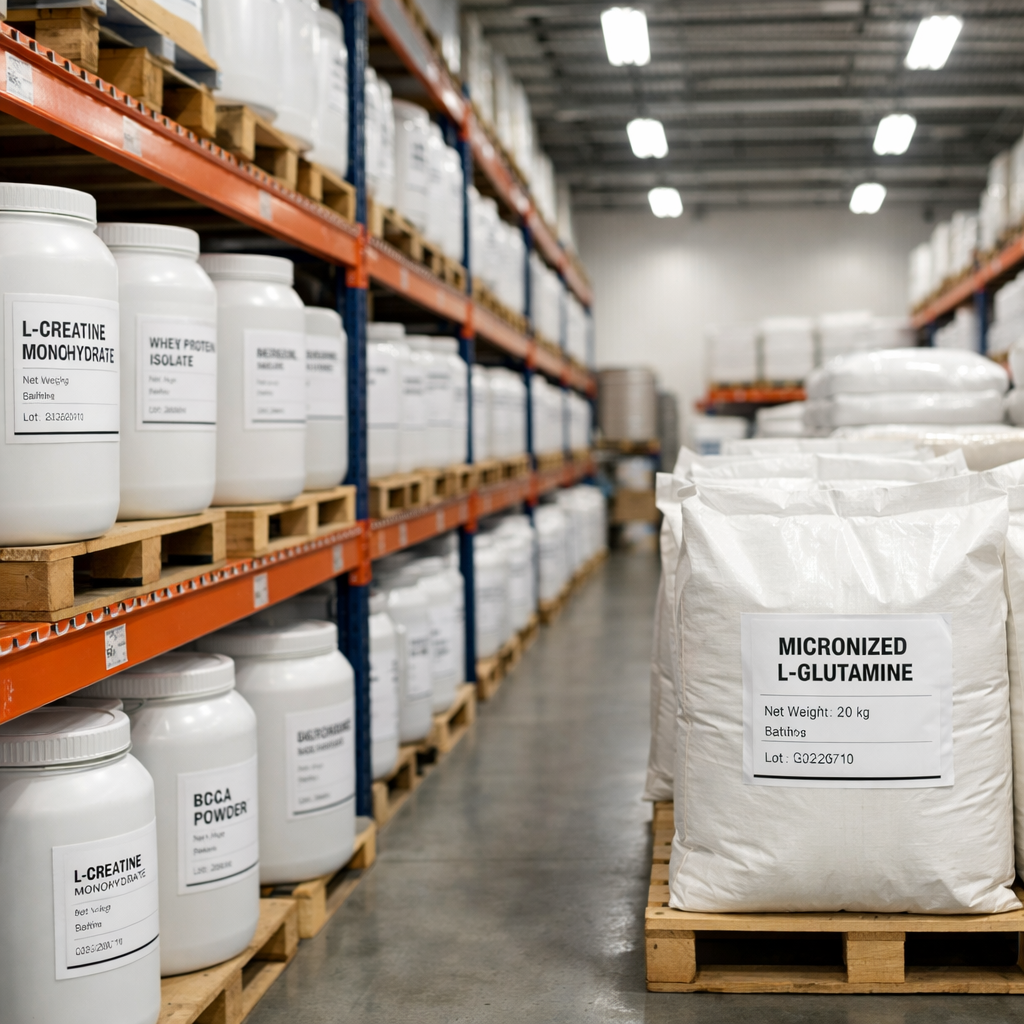
The Cost Gap Between Distributor and Direct
Most supplement brands, especially early-stage ones, buy ingredients from domestic distributors. That arrangement has genuine advantages: no import logistics, fast reorder times, and familiar payment terms. But the price paid for that convenience is real and compounding.
A domestic distributor typically adds 25 to 45 percent margin on top of what they paid their own supplier. That supplier may be a US importer who added their own 15 to 25 percent on top of the manufacturer’s export price. By the time an ingredient reaches a small supplement brand through a two-tier distribution chain, the cost can be two to three times what a direct buyer at equivalent volume would pay.
Consider L-Theanine as a concrete example. At a US distributor level, brands commonly pay $35 to $55 per kilogram for standard pharmaceutical-grade L-Theanine. A brand sourcing the same specification directly from a verified GMP-certified manufacturer in China — with full COAs and third-party testing documentation — can typically access the same material at $18 to $28 per kilogram. On a 100-kilogram order, that difference is $700 to $2,700 in a single purchase. Across a full ingredient portfolio and a year of production runs, the savings restructure the P&L.
The key phrase is “same specification.” Wholesale cost reduction only delivers value when quality is maintained. This is where verification protocols and supplier qualification become the central skill in any procurement strategy.
What Wholesale Actually Means in Supplement Procurement
The term “wholesale” gets used loosely. In supplement ingredient procurement, it typically refers to three distinct sourcing models, each with different cost and risk profiles.
Tier 1 — Direct manufacturer sourcing: Buying directly from the factory that synthesizes or extracts the ingredient. Lowest unit cost, highest documentation depth, but requires the most due diligence, import logistics capability, and typically demands larger minimum order quantities.
Tier 2 — Verified ingredient brokers or trading companies: Intermediaries with established manufacturer relationships who handle logistics, customs, and compliance documentation. Slightly higher cost than direct, but significantly lower operational burden. Quality depends entirely on whether the broker has genuine factory access and independent verification protocols — not just paper certificates.
Tier 3 — Domestic wholesale distributors: US-based companies holding inventory that was sourced upstream. Fastest lead times, but highest cost in the chain. Often the default for brands that have not yet built import infrastructure.
The practical goal for most growing supplement brands is to move from Tier 3 toward Tier 2 while selectively accessing Tier 1 for high-volume ingredients. That transition does not require building a full import operation overnight. It requires finding partners in Tier 2 who operate with the documentation standards and quality verification rigor of Tier 1.
The MOQ Problem — and the Flexible Sourcing Alternative
Minimum order quantities are the most commonly cited reason brands stay with domestic distributors even when they understand the cost math. And it is a legitimate concern. A factory direct engagement might require a full container load — 500 to 1,000 kilograms of a single ingredient — which most brands cannot absorb without tying up significant capital.
This is where the structure of the sourcing partner matters more than the nationality of the supplier.
A growing model among China-to-North America ingredient bridges is the US warehouse model: a verified sourcing company holds inventory from vetted Chinese manufacturers in a domestic US warehouse, enabling orders as small as 25 kilograms — which fits R&D batches and early production runs — while still passing through wholesale pricing because the supplier is aggregating demand across multiple buyers.
The economics work because the aggregator is effectively acting as a buying group. Individual brands access pricing and documentation quality that would otherwise require full container volumes. The tradeoff is a modest premium over true direct-factory pricing, but that premium is far below what domestic distributors charge and comes with the compliance documentation a US supplement manufacturer needs.
“The brands that get stuck are the ones trying to choose between domestic safety and offshore savings. The smarter move is finding a vetted bridge that gives you verified quality at wholesale pricing, starting at volumes that match where you actually are in your growth stage.”
— Dr. Sarah Chen, Supply Chain Specialist, Supplement Manufacturing
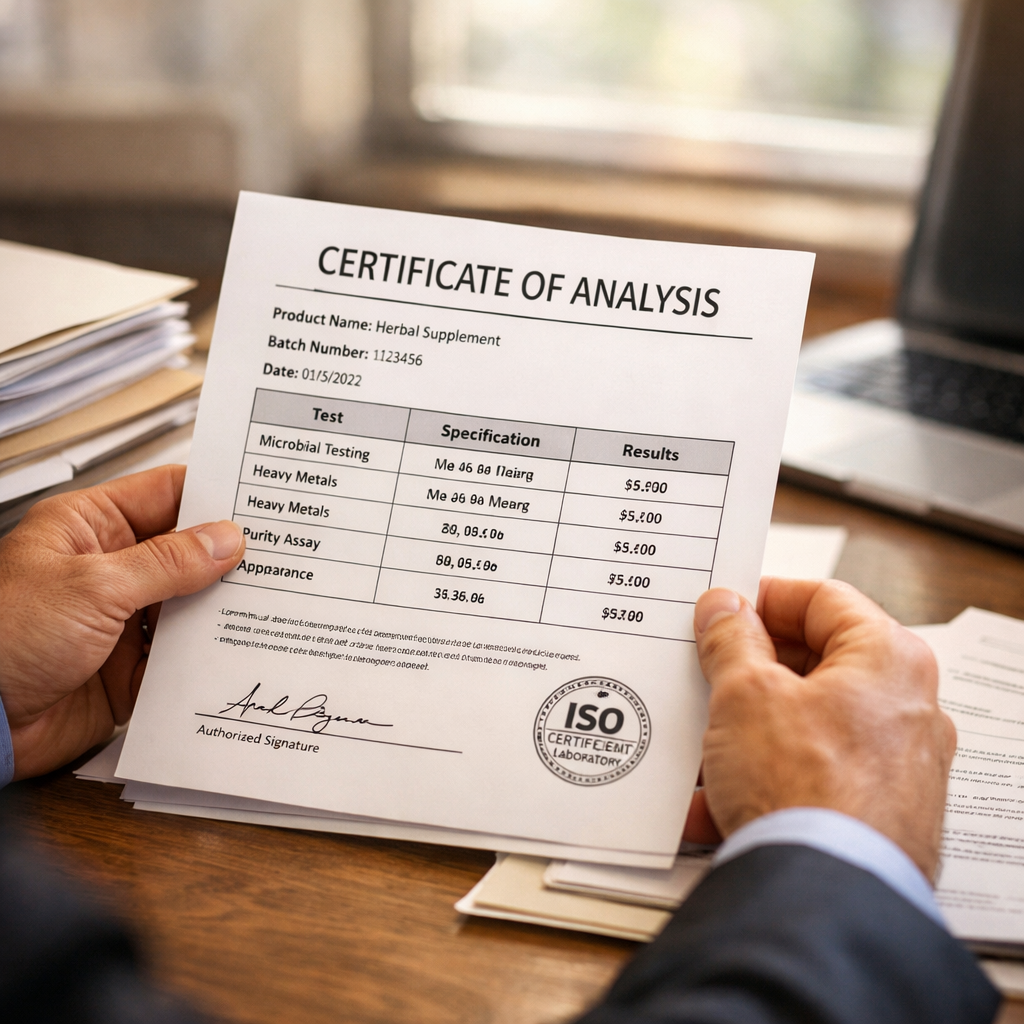
Quality Verification: What the Documentation Actually Needs to Show
The fear that wholesale bulk ingredients from China means compromised quality is understandable given the industry’s history. Adulterated raw materials, falsified certificates of analysis, and undisclosed ingredient substitution have all been documented problems. The solution is not avoiding non-domestic sourcing — it is knowing what a credible quality documentation package actually looks like.
At minimum, a bulk ingredient purchase from any verified wholesale supplier should come with:
- Certificate of Analysis (COA) per lot: Not a generic product COA, but a lot-specific document showing identity confirmation, purity assay, heavy metals panel (lead, arsenic, cadmium, mercury), microbial testing, and moisture content. The testing lab should be third-party, not in-house.
- GMP certification for the manufacturing facility: ISO 22000, HACCP, or cGMP certification from an accredited body. Chinese facilities supplying North American markets should hold these as baseline. NSF International, SGS, and Bureau Veritas are among the recognized auditors. For a detailed breakdown of what GMP audits actually examine, see our guide to GMP certification steps most supplement facilities miss.
- Regulatory documentation: For ingredients entering the US market, this includes documentation supporting GRAS status or dietary ingredient history of use — critical for NDI (New Dietary Ingredient) compliance under DSHEA. The FDA’s dietary supplement framework lays out the specific labeling and documentation requirements that apply.
- Traceability records: The ability to trace the ingredient back to the manufacturing batch, including raw material sources and processing steps. This is what enables effective recall response if a quality event occurs downstream.
A 2021 analysis by the Natural Products Association found that 16 percent of dietary supplement products tested contained ingredient amounts that differed from label claims by more than 20 percent. In almost every case, the root cause traced back to raw material quality failures — either at the supplier or through inadequate incoming testing by the manufacturer. Robust supplier documentation is not bureaucratic overhead. It is the primary risk management tool.
When evaluating a wholesale bulk ingredient supplier, ask this question: can they show you the third-party test results — not just the specification sheet — for the specific lot you are purchasing? A supplier who can answer yes, immediately and without hesitation, has built a verification program. A supplier who hedges has not. For a thorough look at the testing failures that most brands overlook, our analysis of dietary supplement testing services covers the five most common and costly mistakes. The US Pharmacopeia also documents why ingredient-level verification is both a regulatory requirement and a business imperative.
The Real Story on China-Sourced Ingredients
China produces approximately 80 percent of the world’s supply of key supplement ingredients — amino acids, B vitamins, vitamin C, and mineral compounds among them. That is not a statement about quality. It is a statement about industrial scale and specialization built over 40 years of pharmaceutical and nutraceutical manufacturing development.
The problem has never been China’s manufacturing capability. The problem has been the lack of visibility into which facilities operate to what standard — and the proliferation of paper certifications that do not reflect actual operating conditions. This is a documentation and verification problem, not a geography problem.
The regulatory environment has tightened substantially. China’s National Medical Products Administration (NMPA) enforces GMP standards for pharmaceutical manufacturing that overlap significantly with FDA 21 CFR Part 111 requirements. Facilities that export to North American markets increasingly maintain dual compliance — certified under both Chinese national standards and internationally recognized schemes that US supplement manufacturers can rely on.
The practical implication: a brand that sources from a vetted network of certified Chinese manufacturers — with independent audit records, third-party COA verification, and proper import documentation — is operating with a better quality assurance framework than a brand that relies on domestic distributor trust alone. The work is in the qualification upfront. Once a supplier is qualified, the ongoing process is documentation management, not constant re-verification.
Building a Wholesale Sourcing Strategy That Compounds Over Time
The brands that extract maximum value from bulk supplement ingredient sourcing treat it as a system, not a series of one-off transactions. Several structural habits separate effective bulk buyers from those who eventually revert to distributor-level pricing out of operational frustration.
Dual-supply model: Maintain at least two qualified sources for each critical ingredient — one primary supplier and one qualified backup. This protects against supply disruption without requiring massive safety stock. It also gives you ongoing market intelligence on pricing.
Staged commitment: Start with sample orders to qualify a supplier’s documentation and analytical match before committing to production-scale purchases. A supplier unwilling to support sample qualification is a red flag.
Documentation systems before scale: Before a quality event happens, have a defined system for storing, indexing, and retrieving lot-level COAs and compliance documents. FDA inspectors and certification auditors will ask for this. Building it after a problem is always more expensive than building it before.
Negotiate annual pricing frameworks, not just spot orders: As volume and relationship maturity grow, move toward annual pricing agreements with your key wholesale suppliers. This locks in predictable costs, gives the supplier production visibility to serve you better, and creates a genuine partnership rather than a transactional buyer-seller dynamic.
The goal is a procurement operation where cost and quality are not competing variables. Well-structured wholesale sourcing from verified suppliers achieves both simultaneously — not as a compromise, but as a compounding advantage.
What to Look for in a Bulk Ingredient Wholesale Partner
Not all wholesale bulk ingredient suppliers operate the same way. The specific capabilities that matter most to North American supplement brands are worth evaluating explicitly before committing to a sourcing relationship.
Look for suppliers who offer flexible minimum order quantities — ideally starting at 25 kilograms — without requiring container-load commitments at the outset. This matters both for R&D-stage companies and for established brands adding new ingredients to their portfolio without overcommitting capital.
Prioritize partners who maintain US-based inventory for commonly used ingredients. Domestic stock availability removes import lead time risk from your production planning — a critical operational benefit when a formula change or demand spike requires fast ingredient turnaround.
Verify that the supplier’s factory network is independently audited, not self-certified. A credible wholesale ingredient partner should be able to name the third-party auditing body for each manufacturer in their network and provide audit documentation on request. A network of 30-plus GMP/ISO/HACCP certified partner factories took years to qualify — and serious sourcing companies protect that network because it is their core value.
Finally, evaluate responsiveness. An ingredient sourcing partner should be able to respond to specification questions, documentation requests, and pricing inquiries within 48 hours. Slow response time on pre-sale questions is a reliable predictor of slow response time when problems arise post-sale.
The economics of bulk supplement ingredient wholesale sourcing are straightforward. The execution requires choosing the right partner and building the right internal processes to manage documentation at scale. Brands that do both consistently find that their ingredient costs stop being a ceiling on their margins and start being a structural advantage over competitors still paying distributor rates. If you are ready to evaluate a sourcing partnership built on verified quality and flexible order sizes, contact NutraAeon to discuss your ingredient requirements.