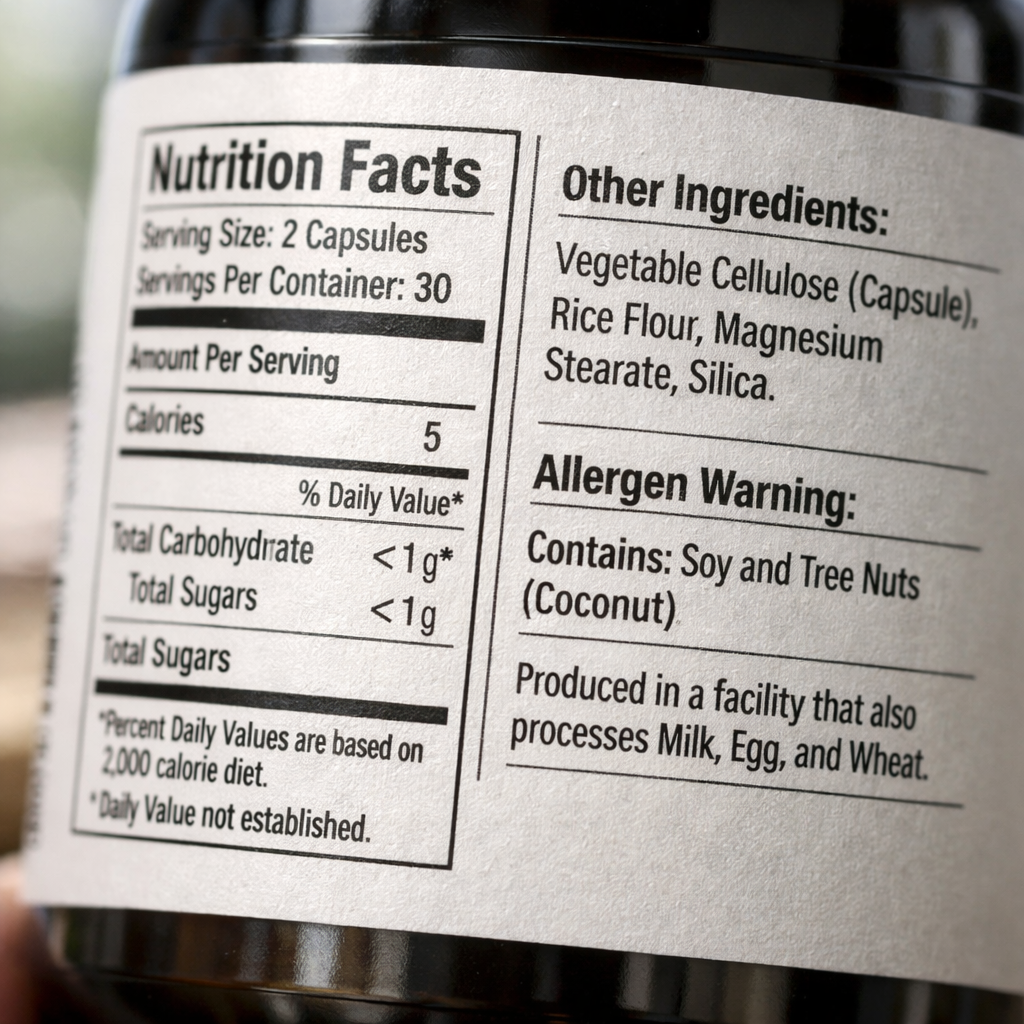
You’ve spent months perfecting your supplement formula. You’ve sourced premium ingredients, conducted stability testing, and validated your product’s efficacy. But there’s one critical step standing between your innovation and market success: creating a compliant, professional supplement label that communicates value while meeting regulatory standards.
An ingredients label maker isn’t just a design tool—it’s the bridge that transforms your supplement concept into a market-ready product. For forward-thinking manufacturers partnering with global nutritional ingredients suppliers like NutraAeon, understanding the labeling process is essential. A well-crafted label does more than list ingredients; it builds consumer trust, ensures regulatory compliance, and differentiates your product in a crowded marketplace.
The journey from raw materials to retail-ready supplements requires precision at every step. At NutraAeon, we understand that quality ingredients deserve equally exceptional presentation. Our commitment to transparency extends beyond certificates of analysis—it encompasses the entire process of bringing premium nutritional products to market, including the critical labeling phase that makes or breaks consumer confidence.

Understanding the Regulatory Framework Governing Supplement Labels
Before you create a single design element, you must understand the regulatory landscape. In the United States, dietary supplement labeling is governed primarily by 21 CFR 101.36 and the FDA Dietary Supplement Labeling Guide. These regulations aren’t suggestions—they’re mandatory requirements that protect consumers and ensure fair competition.
The FDA requires specific elements on every dietary supplement label. The statement of identity clearly declares what the product is—for example, “Magnesium Supplement” or “Amino Acid Complex.” This statement must be prominent and unambiguous, leaving no doubt about the product’s nature.
Net quantity of contents tells consumers exactly how much product they’re purchasing, expressed in both metric and US customary units. For capsules or tablets, this includes the count alongside the total weight. Directions for use provide clear guidance on how to consume the product safely and effectively, while the manufacturer’s or distributor’s name and address establish accountability.
Allergen information is non-negotiable. If your supplement contains common allergens like soy, wheat, or shellfish-derived ingredients, these must be clearly declared. This transparency isn’t just regulatory compliance—it’s a matter of consumer safety. When NutraAeon sources ingredients like amino acids or vitamin complexes, we provide complete allergen documentation, enabling manufacturers to create accurate, honest labels.
The Supplement Facts panel is the heart of your label, governed by specific formatting requirements that differ from standard Nutrition Facts panels on foods. This distinction is important—supplements follow unique rules designed specifically for nutritional products that aren’t consumed as conventional foods.
Mastering the Supplement Facts Panel
The Supplement Facts panel is where regulatory compliance meets consumer communication. This section requires meticulous attention to detail, as errors here can lead to costly recalls, regulatory warnings, or consumer harm.
Serving size is your foundation. It must reflect a realistic consumption pattern and remain consistent across similar products. For a magnesium supplement, a serving might be one or two capsules. For an amino acid powder, it could be one scoop measuring 5 grams. The FDA doesn’t dictate serving sizes for supplements, but your choice must be reasonable and defensible.
Each ingredient listed must show the amount per serving with appropriate units. Here’s where many manufacturers stumble: you must report elemental amounts, not compound weights. If you’re using NutraAeon’s premium Magnesium Oxide in your formulation, you don’t simply list the total weight of magnesium oxide—you calculate and report the elemental magnesium content.
For example, if each serving contains 500mg of magnesium oxide, the elemental magnesium is approximately 300mg. This calculation matters enormously. Consumers comparing products need accurate information, and regulatory agencies expect precision. An ingredients label maker designed for supplements handles these calculations automatically, reducing the risk of costly errors.
Daily Values (DVs) provide context for nutrient amounts. The FDA has established DVs for many vitamins and minerals. For nutrients with established DVs, you must include the percentage in your Supplement Facts panel. For nutrients without established DVs, you may list the amount without a percentage, but you cannot make up your own DV—the FDA’s values are the only acceptable reference points.
When working with NutraAeon’s Vitamin Series—including various forms of Vitamin C, Vitamin E tocopherols, and B-Complex vitamins—accurate DV calculations are straightforward because these nutrients have well-established daily values. However, for specialized ingredients like L-Theanine or L-Tryptophan from our Amino Acid Series, DVs may not exist, requiring a different labeling approach.
Ingredient lists follow a specific order: dietary ingredients with established DVs appear first in descending order by weight, followed by dietary ingredients without DVs, also in descending weight order. Botanical ingredients require both common and Latin names. Proprietary blends require special handling—you must list the total blend weight and identify all components, even if you don’t disclose individual amounts.
Design and Readability Best Practices
Regulatory compliance is mandatory, but effective communication requires more than meeting minimum requirements. Your supplement label must be readable, accessible, and professionally designed to build trust and facilitate informed decision-making.
Typography matters more than most manufacturers realize. The FDA specifies minimum type sizes for different label elements, but going beyond these minimums improves accessibility. Use clean, sans-serif fonts for the Supplement Facts panel—fonts like Helvetica or Arial ensure legibility across different lighting conditions and viewing distances.
Layout should follow a logical hierarchy. The product name captures attention first, followed by the Supplement Facts panel, then additional claims or usage instructions. White space isn’t wasted space—it improves comprehension and prevents your label from appearing cluttered or overwhelming.
High-contrast text is essential. Black text on white backgrounds provides maximum readability, particularly for older consumers or those with visual impairments. If your brand requires colored backgrounds, ensure sufficient contrast testing to maintain legibility. Tools exist to measure contrast ratios—aim for WCAG AAA standards when possible.
The column structure within the Supplement Facts panel should be clean and consistent. Amounts, units, and %DV values must align properly to prevent misreading. An ingredients label maker with built-in formatting ensures these elements maintain proper spacing and alignment automatically.
Language accessibility extends beyond English. If you’re targeting diverse markets, consider bilingual labels or separate labels for different regions. However, all labels sold in the United States must include English text, even when additional languages are present.
Consistency across your product line builds brand recognition and trust. If you manufacture multiple supplements using different ingredients from NutraAeon’s portfolio—perhaps a sleep formula with L-Tryptophan, a stress relief product with L-Theanine, and a sports nutrition line with Glycine—maintaining consistent label design strengthens your brand identity while simplifying regulatory compliance.
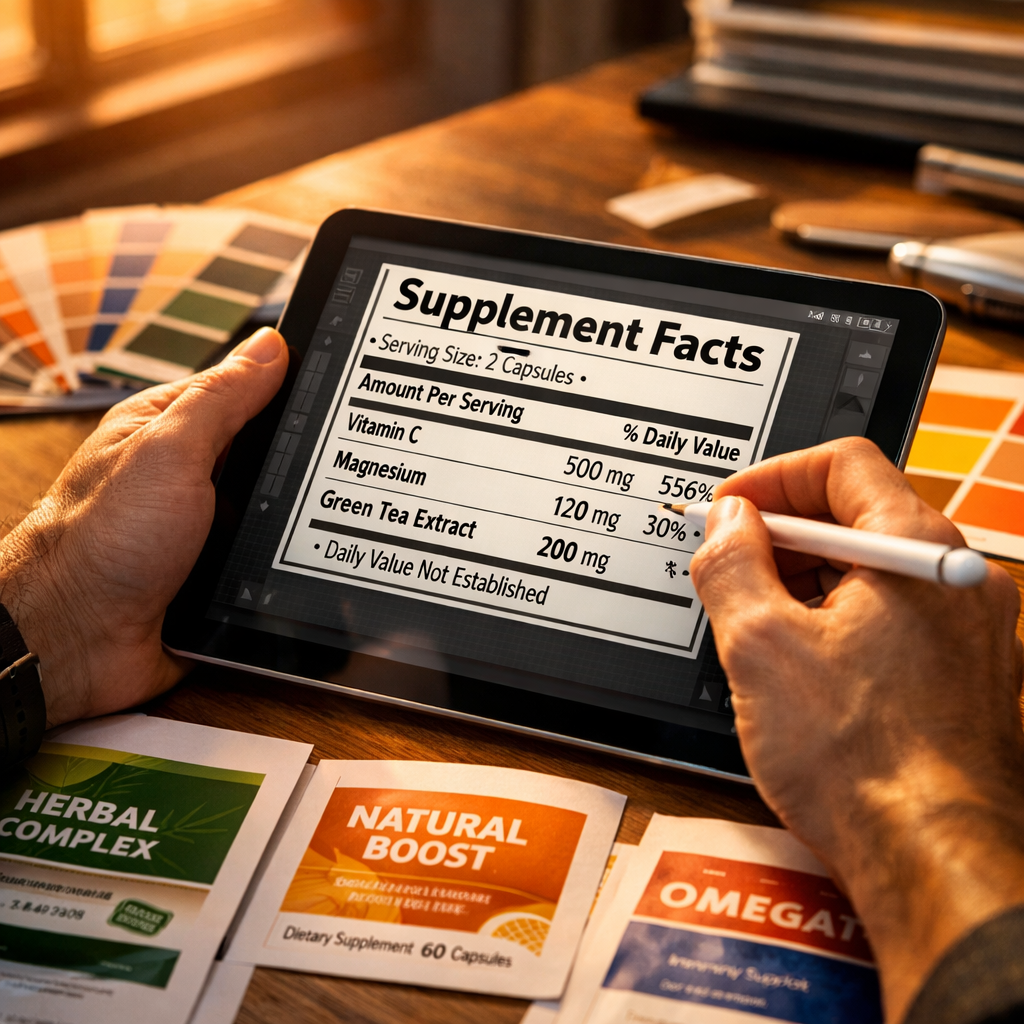
Creating Your Professional Label: A Step-by-Step Process
Transforming your supplement idea into a market-ready product requires a systematic approach to label creation. Here’s how to navigate this process efficiently and accurately.
Start by gathering complete, accurate data for every ingredient. When you source from NutraAeon, you receive comprehensive specifications including elemental content, potency levels, and any relevant processing information. This documentation forms the foundation of your label accuracy. Don’t estimate or round prematurely—work with exact figures initially, then apply FDA rounding rules at the appropriate stage.
Draft your Supplement Facts panel structure before diving into design. List all ingredients, calculate elemental amounts, determine serving sizes, and verify daily value percentages. This working document becomes your blueprint, ensuring nothing is overlooked when the design process begins.
Choose your label maker tool carefully. Specialized software designed for supplement manufacturers understands the unique requirements of 21 CFR 101.36. These tools embed regulatory rules, automatically format Supplement Facts panels, calculate %DV values, and apply correct rounding procedures. Generic design software requires manual implementation of these rules, increasing error risk.
Validate your draft against regulatory requirements. Check that all required elements appear in the correct format and location. Verify calculations, particularly for ingredients like NutraAeon’s mineral compounds where elemental content differs significantly from compound weight. Confirm that allergen statements are complete and accurate.
Review readability and visual hierarchy. Print a physical proof at actual size—what appears clear on a computer screen may be illegible on a small bottle. Have team members from different departments review the label. Fresh eyes catch errors that familiar reviewers miss.
Prepare your label for production by ensuring your design files meet printer specifications. Resolution, color space, bleed areas, and file formats all matter. Work with label printing specialists who understand supplement industry requirements—they can identify potential production issues before they become costly problems.
Avoiding Common Pitfalls
Even experienced manufacturers make labeling mistakes. Learning from common pitfalls saves time, money, and regulatory headaches.
Inaccurate serving sizes create cascading problems. If you establish an unrealistic serving size to make nutrient percentages look impressive, consumers may unknowingly underdose or overdose. Serving sizes should reflect reasonable usage patterns based on scientific evidence and industry standards.
Misleading claims trigger FDA enforcement. Statements like “cures,” “treats,” or “prevents” cross the line from dietary supplements into drug territory, requiring different regulatory pathways. Structure/function claims are permissible when properly qualified, but they require substantiation and must include the disclaimer: “This statement has not been evaluated by the Food and Drug Administration. This product is not intended to diagnose, treat, cure, or prevent any disease.“
Incomplete ingredient disclosure undermines consumer trust and violates regulations. Every ingredient must appear on the label, even if present in tiny amounts. When formulating with NutraAeon’s ingredients, our transparent supply chain documentation ensures you have complete information about every component, including processing aids and flow agents.
Poor update management causes version control issues. When you reformulate, labels must change immediately. Operating procedures should link formulation changes directly to label updates, preventing situations where old labels accompany new formulas or vice versa.
Neglecting international requirements limits market expansion. If you plan to sell in Canada, Europe, or other markets, their labeling requirements differ from FDA rules. Design flexibility into your labeling system to accommodate multiple regulatory frameworks without complete redesigns.
The NutraAeon Advantage in Label Creation
At NutraAeon, our commitment to quality, transparency, and empowerment extends directly to the labeling process. When you partner with us for nutritional ingredients—whether amino acids like L-Serine for cognitive support, vitamin compounds such as Vitamin C Palmitate, or mineral ingredients like food-grade Magnesium Oxide—you receive more than raw materials.
Our comprehensive documentation packages include everything needed for accurate label creation: certificates of analysis, ingredient specifications, elemental content calculations, allergen statements, and regulatory status confirmations. This information integrates directly into your labeling process, reducing errors and accelerating time-to-market.
We understand that exceptional ingredients deserve exceptional presentation. A supplement containing our high-purity L-Theanine for stress relief or premium B-Complex vitamins should communicate its quality through every touchpoint, including the label. Accurate, compliant, professionally designed labels reinforce the premium positioning that our ingredients enable.
Our global sourcing network means you can access superior ingredients while maintaining complete supply chain visibility. This transparency isn’t just good business practice—it’s essential for creating honest, accurate labels that build lasting consumer relationships.
Conclusion: From Concept to Confidence
An ingredients label maker transforms your supplement from a promising idea into a market-ready product by bridging the gap between innovation and regulation, between ingredient quality and consumer communication. The process requires attention to detail, regulatory knowledge, and commitment to transparency—values that align perfectly with NutraAeon’s philosophy.
Quality ingredients from reliable suppliers deserve quality presentation. When you source amino acids, vitamins, or minerals from NutraAeon, you’re building on a foundation of excellence that extends from molecular purity to market presence. Your label is the final expression of this commitment, communicating value to consumers while meeting regulatory standards.
The supplement industry continues evolving, with increasingly sophisticated consumers demanding transparency and increasingly vigilant regulators enforcing compliance. Manufacturers who embrace these standards—who invest in proper labeling tools, who partner with transparent suppliers, who prioritize accuracy over shortcuts—position themselves for sustainable success.
Your supplement label isn’t just a regulatory requirement or a marketing tool. It’s a promise to consumers, a statement of values, and a reflection of your commitment to quality. Make it count.