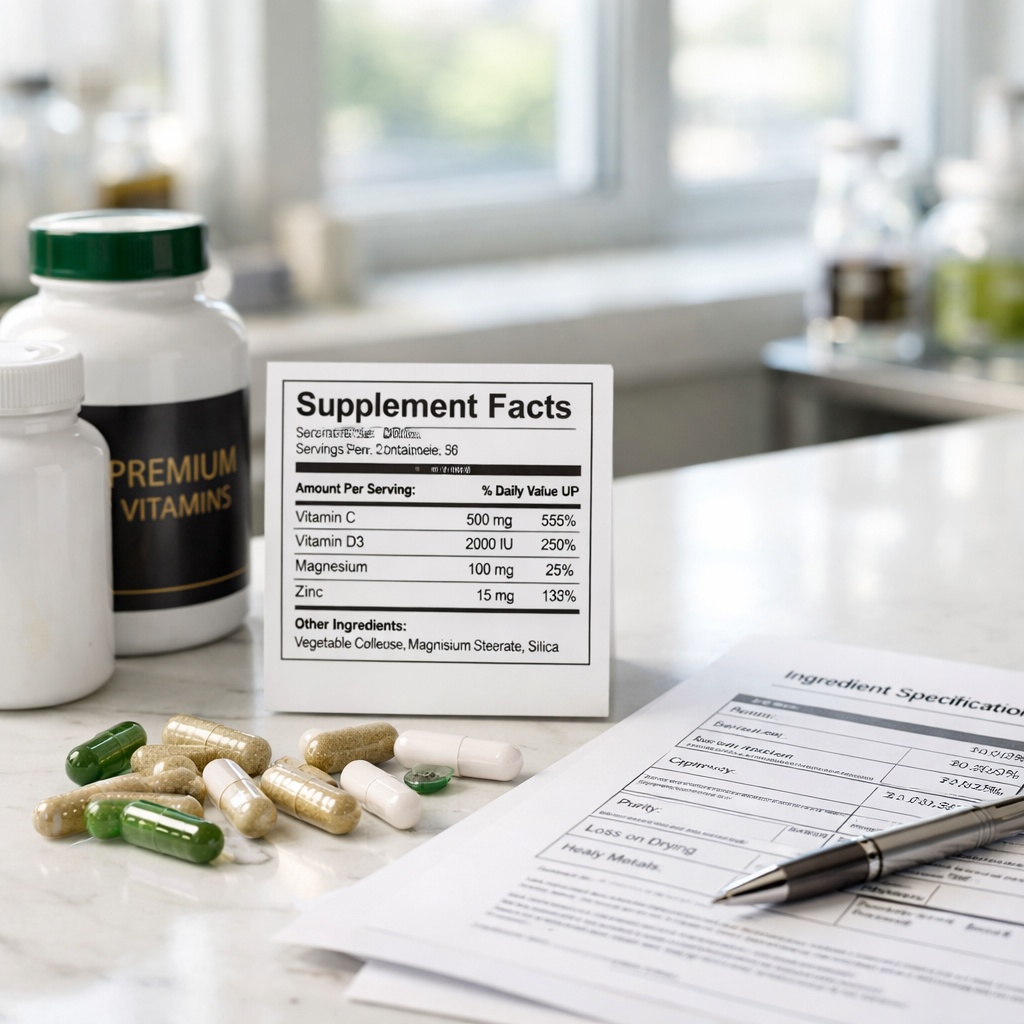
In today’s competitive supplement and food manufacturing landscape, an accurate ingredients label template isn’t just a regulatory checkbox—it’s the foundation of consumer trust and brand credibility. For private label manufacturers and brands seeking to deliver transparency alongside quality, mastering FDA-compliant labeling becomes a competitive advantage rather than merely a compliance burden. When consumers scan your product on a retail shelf or review it online, that label serves as your first—and sometimes only—conversation with them about what’s inside and why it matters.
The stakes couldn’t be higher. According to recent FDA enforcement data, labeling violations remain among the top reasons for warning letters issued to food and supplement manufacturers. Beyond regulatory consequences, inaccurate or misleading labels erode the consumer confidence that modern health-conscious buyers demand. Whether you’re formulating sports nutrition products with premium amino acids or developing wellness supplements enriched with high-purity vitamins, your label must communicate exactly what you’re delivering—clearly, accurately, and compliantly.
Understanding FDA Regulatory Foundations for Packaged Foods
The FDA establishes comprehensive labeling requirements for packaged foods and dietary supplements under the Federal Food, Drug, and Cosmetic Act. These regulations exist to protect consumers by ensuring they receive accurate information about what they’re consuming, particularly regarding ingredients, allergens, and nutritional content.
At the core of FDA requirements lies the principle of truthful disclosure. Every packaged food product must include a complete ingredient list that declares all components in descending order of predominance by weight. This means the ingredient present in the greatest amount appears first, followed by others in decreasing order. This transparency allows consumers to make informed decisions based on their dietary needs, preferences, and health considerations.
Allergen declarations represent another critical regulatory foundation. The Food Allergen Labeling and Consumer Protection Act requires clear identification of major food allergens—milk, eggs, fish, crustacean shellfish, tree nuts, peanuts, wheat, and soybeans. These allergens must be declared either within the ingredient list using their common names or in a separate “Contains” statement immediately following the ingredient list. For manufacturers incorporating ingredients like whey protein isolate or amino acids derived from fermentation processes, understanding allergen source disclosure becomes essential.
The Nutrition Facts Panel adds another layer of mandatory information, providing consumers with standardized data about serving sizes, calories, and nutrient content. Recent FDA updates to nutrition labeling requirements reflect evolving dietary science and public health priorities, including clearer serving size declarations and added sugars information. For supplement manufacturers working with ingredients like vitamin C palmitate or magnesium oxide, accurate nutrient quantification directly impacts the values displayed on this panel.
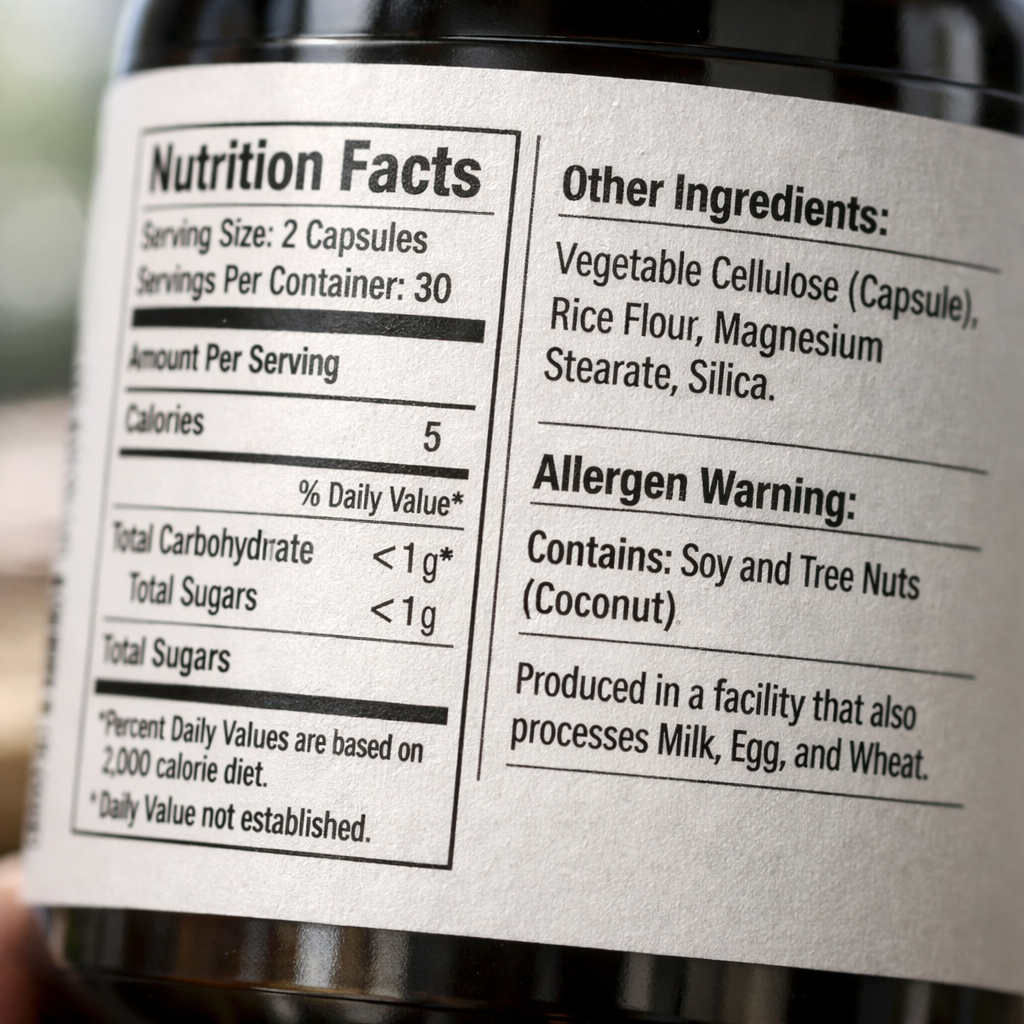
Essential Components of a Compliant Label
Creating a compliant label requires attention to multiple mandatory elements, each serving a specific purpose in consumer communication and regulatory adherence.
Product Identity and Name: Your label must clearly state what the product is using terms consumers understand. Whether it’s “Mixed Berry Protein Powder” or “Daily Vitamin C Supplement,” the name should accurately reflect the product’s nature without making unauthorized health claims.
Net Weight or Volume: The net quantity declaration tells consumers exactly how much product they’re purchasing, stated in both metric and U.S. customary units. This information must appear on the principal display panel in a size proportional to the package dimensions.
Ingredient List: This section demands meticulous accuracy. Every ingredient must be listed by its common or usual name, and sub-ingredients within compound ingredients must also be declared. For example, if your formulation includes a proprietary amino acid blend containing L-theanine, L-tryptophan, and glycine, each component requires individual listing unless specific regulatory exemptions apply.
Allergen Disclosures: As mentioned earlier, major allergens need clear, unambiguous declaration. This becomes particularly important when working with ingredients processed in facilities that also handle allergens, requiring “may contain” or “processed in a facility” statements.
Manufacturer Information: The label must identify the manufacturer, packer, or distributor with a complete street address. This ensures accountability and provides consumers with contact information for questions or concerns.
Barcode and Product Codes: Most retail distribution requires a UPC barcode for inventory tracking and point-of-sale scanning. Additionally, including batch or lot codes facilitates traceability and supports recall management if issues arise.
Label legibility extends beyond regulatory compliance to practical consumer experience. The FDA specifies minimum type sizes for various label elements, ensuring readability under normal shopping conditions. Typography choices should prioritize clarity over aesthetics, using sufficient contrast between text and background.
Material durability matters too. Labels must withstand the product’s intended storage conditions—whether refrigeration, freezing, or ambient shelf storage—without smudging, peeling, or becoming illegible. For supplement bottles containing hygroscopic ingredients like certain vitamin forms, moisture-resistant label materials become essential.
Private Label Dynamics: Partnerships and Responsibilities
Private label manufacturing involves unique dynamics where retailers or brand owners contract with manufacturers to produce products sold under the retailer’s brand. This arrangement creates specific responsibilities that both parties must understand to ensure labeling compliance.
The brand owner typically controls label design, branding elements, and marketing claims, while the manufacturer bears responsibility for accurate formulation data, ingredient sourcing documentation, and production specifications. This division of responsibilities requires clear communication and documented agreements specifying who verifies regulatory compliance, approves final label proofs, and maintains certificates of analysis for raw materials.
Quality assurance becomes a shared responsibility. While manufacturers must ensure formulation accuracy and production consistency, brand owners must verify that marketing claims align with substantiation requirements and that labels accurately represent the finished product. For example, if a private label protein powder claims “20g of premium amino acids per serving,” both the formulator and brand owner share responsibility for ensuring this declaration matches laboratory analysis results.
Successful private label partnerships often leverage standardized templates that streamline label creation while maintaining consistency across product lines. These templates incorporate mandatory regulatory elements while allowing customization of branding and product-specific information. Modern label management software can automate much of this process, reducing errors while accelerating time-to-market for new product launches.
Step-by-Step Workflow for Creating Compliant Labels
Building an ingredients label template that consistently delivers FDA compliance requires a systematic approach. Here’s a proven workflow that addresses both regulatory requirements and practical production needs.
Step 1: Define Regulatory Scope: Begin by determining your product category—conventional food, dietary supplement, or functional food—as different categories trigger different labeling requirements. Dietary supplements, for instance, require a Supplement Facts panel rather than a Nutrition Facts panel and follow specific ingredient declaration rules under 21 CFR Part 101.
Step 2: Gather Complete Formulation Data: Collect comprehensive information about every ingredient, including common names, scientific names where applicable, percentage composition, and supplier specifications. For ingredients like L-serine or vitamin E tocopherols, obtain allergen statements and certificates of analysis from your ingredient supplier. At NutraAeon, we provide complete documentation packages for every ingredient we supply, ensuring you have the data foundation for accurate labeling.
Step 3: Conduct Nutrition Analysis: Use professional nutrition analysis software or laboratory testing to determine nutritional values for your Nutrition Facts or Supplement Facts panel. While databases provide starting points, finished product testing offers the highest accuracy, particularly for products with complex formulations or unique processing methods.
Step 4: Draft Ingredient List: Arrange ingredients in descending order by weight, using their common or usual names. Apply specific rules for compound ingredients—if a compound ingredient comprises less than two percent of the finished product, its sub-ingredients may sometimes be listed in parentheses rather than separately.
Step 5: Add Mandatory Statements: Include all required declarations—allergen statements, health warnings where applicable, storage instructions, and any category-specific requirements. For amino acid supplements, this might include statements about intended use or consultation recommendations.
Step 6: Select Appropriate Label Materials: Choose label substrates and adhesives suited to your product packaging and storage conditions. Consider factors like moisture exposure, temperature fluctuations, and anticipated shelf life. Work with label manufacturers who understand FDA requirements for label durability and readability.
Step 7: Design for Readability and Compliance: Layout your label elements to meet FDA placement and sizing requirements while maintaining visual appeal. The principal display panel must contain specific information in prescribed locations and sizes, while the information panel accommodates ingredient lists and nutritional data.
Step 8: Conduct Quality Assurance Review: Before final printing, conduct thorough reviews involving regulatory experts, quality assurance teams, and stakeholder approvals. Create a documented checklist covering every regulatory requirement and verify accuracy against formulation specifications. This final gate-keeping step prevents costly reprinting and potential regulatory issues.

Best Practices for Label Design and Management
Beyond basic compliance, implementing best practices elevates your labeling program from adequate to excellent, supporting both regulatory adherence and consumer trust.
Use Clear, Consumer-Friendly Language: While you must use scientifically accurate ingredient names, choose the most recognizable form when options exist. “Vitamin C” communicates more clearly to consumers than “ascorbic acid,” though both are technically correct. For specialized ingredients like magnesium oxide, consider including brief, compliant explanatory text that helps consumers understand the ingredient’s role.
Avoid Misleading Claims: The FDA scrutinizes label claims closely, distinguishing between structure/function claims (which are permissible for supplements with proper substantiation) and disease claims (which are generally prohibited). Claims like “supports immune health” may be acceptable with proper disclaimers, while “prevents colds” crosses into disease claim territory. When incorporating premium ingredients like L-theanine known for supporting relaxation, ensure your claims reflect permitted language backed by scientific evidence.
Maintain Consistency Across Product Lines: Establish standardized formatting, terminology, and design elements across your product portfolio. Consistency builds brand recognition while simplifying compliance management. If your protein powder line uses specific formatting for amino acid content declarations, maintain that same approach across flavors and formulations.
Stay Updated with Regulatory Changes: FDA guidance evolves as new scientific evidence emerges and public health priorities shift. Subscribe to FDA updates, participate in industry associations, and consider engaging regulatory consultants who monitor developments affecting your product categories. Recent years have seen significant updates to nutrition labeling requirements, serving size determinations, and added sugars declarations.
Vet Your Ingredient Suppliers: Compliance begins with your supply chain. Partner with ingredient suppliers who provide comprehensive documentation, maintain rigorous quality standards, and understand their role in your labeling accuracy. When you work with suppliers like NutraAeon who specialize in premium nutritional ingredients with complete analytical documentation, you build confidence that your label declarations match what’s actually in your formulation.
Common Pitfalls and How to Avoid Them
Even experienced manufacturers occasionally stumble over labeling requirements. Understanding common mistakes helps you avoid them.
Incorrect Ingredient Order: Remember that predominance is determined by weight in the formulation, not volume or perceived importance. Failing to accurately weigh and sequence ingredients creates immediate compliance issues. Maintain detailed batch records that document actual weights used in production runs.
Missing or Incomplete Allergen Disclosures: Allergen disclosure errors create serious consumer safety risks and regulatory liability. Establish clear procedures for tracking allergens throughout your facility, including shared equipment protocols. If equipment used for processing your vitamin C supplement also handles dairy-based protein powders, appropriate allergen declarations become mandatory.
Inadequate Label Material Selection: Labels that fade, smudge, or peel compromise both compliance and brand perception. Test label durability under realistic storage conditions before committing to large production runs. Consider accelerated aging studies for products with extended shelf lives.
Overstating Nutrient Content: Declaring nutrients that exceed actual tested values creates regulatory violations. Build appropriate overages into formulations to account for nutrient degradation over shelf life, but ensure label claims remain conservative and accurate based on testing at end of shelf life.
Neglecting Batch-Specific Verification: While templates streamline label creation, each production batch deserves verification that actual formulation matches label declarations. Manufacturing variations, ingredient substitutions, or process changes can affect finished product composition.
Your Compliance Checklist
Before releasing any new label design, verify completion of these essential elements:
- Product identity clearly stated on principal display panel
- Net weight/volume declared in required units and type size
- Complete ingredient list in descending order by weight
- All major allergens identified clearly
- Nutrition Facts or Supplement Facts panel with accurate values
- Manufacturer/distributor contact information complete
- Appropriate barcodes and batch codes included
- All typography meets minimum size requirements
- Label material suitable for product storage conditions
- No unauthorized health claims or misleading statements
- Internal QA review documented and approved
- Regulatory expert review completed if needed
Building Excellence Through Compliance
An ingredients label template represents more than regulatory compliance—it embodies your commitment to transparency, quality, and consumer empowerment. When done well, your label becomes a trust-building tool that differentiates your brand in crowded markets.
At NutraAeon, we understand that exceptional products begin with exceptional ingredients, supported by complete documentation and transparent supply chains. Our philosophy of quality, transparency, and empowerment extends beyond the premium amino acids, vitamins, and minerals we supply. We partner with manufacturers who share our commitment to excellence, providing not just raw materials but the comprehensive analytical documentation and technical support that make accurate, compliant labeling achievable.
Whether you’re formulating sports nutrition products that leverage the cognitive benefits of L-theanine, developing sleep support supplements with pharmaceutical-grade L-tryptophan, or creating wellness products fortified with our complete vitamin series, your labeling accuracy begins with ingredient quality and documentation. Every ingredient in our portfolio comes with complete certificates of analysis, allergen statements, and technical specifications that support your labeling requirements.
The eight-step blueprint outlined here provides a roadmap for creating labels that meet regulatory standards while communicating clearly with consumers. By implementing systematic workflows, leveraging best practices, and partnering with suppliers who prioritize quality and transparency, you build labeling programs that support both compliance and market success. Your label isn’t just a legal requirement—it’s your promise to consumers and your foundation for building lasting brand trust in an industry where transparency matters more than ever.