Every day, supplement manufacturers face a critical challenge: how can you be absolutely certain that what’s on your label matches what’s in your bottle? For forward-thinking developers and health-conscious product manufacturers, this question isn’t just about regulatory compliance—it’s about protecting your reputation and your customers’ wellbeing.
The supplement industry has grown exponentially, but with that growth comes increased scrutiny. Consumers are more educated than ever, asking tough questions about ingredient quality, potency accuracy, and manufacturing integrity. Meanwhile, manufacturers and developers must navigate complex labeling requirements while ensuring their products deliver exactly what they promise. A single discrepancy between your label claims and actual content can undermine years of trust-building and brand development.
This is where understanding how to properly verify supplement quality becomes not just important, but essential. Whether you’re formulating a new product line, evaluating potential ingredient suppliers, or conducting routine quality checks, having the right tools and knowledge can make the difference between excellence and costly mistakes.

Reading Between the Lines: What Your Supplement Label Really Tells You
The Supplement Facts panel isn’t just a regulatory requirement—it’s a window into product integrity. Under FDA guidance and 21 CFR 101.36, dietary supplement labels must present information in a specific format that enables accurate assessment of nutritional content.
Start with the basics. The Supplement Facts panel must clearly display serving size, servings per container, and a complete list of declared dietary ingredients. These seemingly simple elements tell a sophisticated story. The serving size determines how all other values are calculated, making it the foundation of label accuracy. If a manufacturer lists an unrealistic serving size—perhaps unusually small to make nutrient values look more impressive—that’s your first red flag.
Look closely at how ingredients are listed. Active ingredients should appear with their amount per serving, followed by the % Daily Value when applicable. The order matters too. Ingredients must be listed in descending order by weight, giving you immediate insight into what dominates the formula. A product claiming to feature a premium ingredient should list it prominently, not buried at the bottom of a proprietary blend.
Transparency in labeling separates quality manufacturers from questionable operators. When you see clear, detailed information about each ingredient—including its specific form (like “Magnesium as Magnesium Oxide” rather than just “Magnesium”)—you’re looking at a company that understands both regulatory requirements and consumer expectations. This level of detail allows you to trace ingredients back to their sources, verify their bioavailability, and confirm they match your formulation specifications.
Decoding NRV: The Numbers That Matter
Understanding Nutrient Reference Values (NRV), often expressed as % Daily Value (% DV) on U.S. labels, transforms how you evaluate supplement quality. For a comprehensive breakdown of these standards, explore our recommended dietary allowance table guide. These percentages aren’t arbitrary—they represent how much of the recommended daily intake a single serving provides based on a 2,000-calorie diet for adults.
Here’s why this matters for manufacturers and developers: NRV percentages reveal whether your formulation delivers meaningful amounts of nutrients or just marketing-friendly label claims. A supplement containing 2% DV of Vitamin C might technically allow you to list Vitamin C as an ingredient, but it won’t deliver the functional benefits consumers expect. Conversely, products exceeding 100% DV for certain nutrients require careful consideration of tolerable upper intake levels.
For consumers evaluating supplements, NRV percentages provide a quick benchmark. If you’re taking multiple supplements or consuming fortified foods, adding up the % DV across all sources helps prevent both deficiency and excess. A multivitamin providing 100% DV of most vitamins, combined with fortified breakfast cereal offering another 25% DV, plus additional standalone supplements, could potentially push you into excessive intake territory for certain nutrients. Understanding daily intake requirements for vitamins and minerals helps prevent both deficiency and excess.
This calculation becomes particularly important when working with specific populations. Athletes may require higher nutrient levels than the standard NRV, while elderly individuals might need adjustments based on absorption efficiency. Understanding NRV empowers both manufacturers to formulate appropriately targeted products and consumers to make informed decisions about their supplement regimen.
Quality Signals: Certifications That Mean Something
Not all quality claims carry equal weight. Third-party certifications from organizations like USP (United States Pharmacopeia) and NSF International represent independent verification that a supplement meets rigorous standards for identity, strength, quality, and purity.
These certifications matter because they’re expensive and demanding to obtain. A manufacturer must submit their products for comprehensive testing, open their facilities to inspection, and maintain consistent quality standards to retain certification. Learn more about USP’s verification process and standards. USP Verified marks confirm that the product contains the ingredients listed on the label in the declared potency and amounts, will break down and release into the body within a specified time, has been screened for harmful contaminants, and was manufactured using Good Manufacturing Practice (GMP) standards.
NSF certification programs offer similar verification. NSF Certified for Sport goes further by testing for athletic banned substances, making it essential for sports nutrition products. The NSF Contents Certified program verifies label claims and assesses environmental contaminants, providing an additional layer of quality assurance.
When evaluating ingredients for your formulations, supplier certifications become equally important. At NutraAeon, we understand that your product quality begins with raw material excellence. That’s why we partner exclusively with suppliers who maintain rigorous testing protocols and can provide complete documentation including certificates of analysis, heavy metal testing results, and microbiological screening. Discover our approach to ingredient quality verification. This upstream quality control ensures that by the time ingredients reach your manufacturing facility, they’ve already passed multiple verification checkpoints.
Look for these certification marks when sourcing ingredients or evaluating finished products. Their presence indicates a manufacturer’s commitment to transparency and willingness to submit to independent oversight—hallmarks of quality-focused operations.
Putting Free Calculators to Work: A Step-by-Step Approach
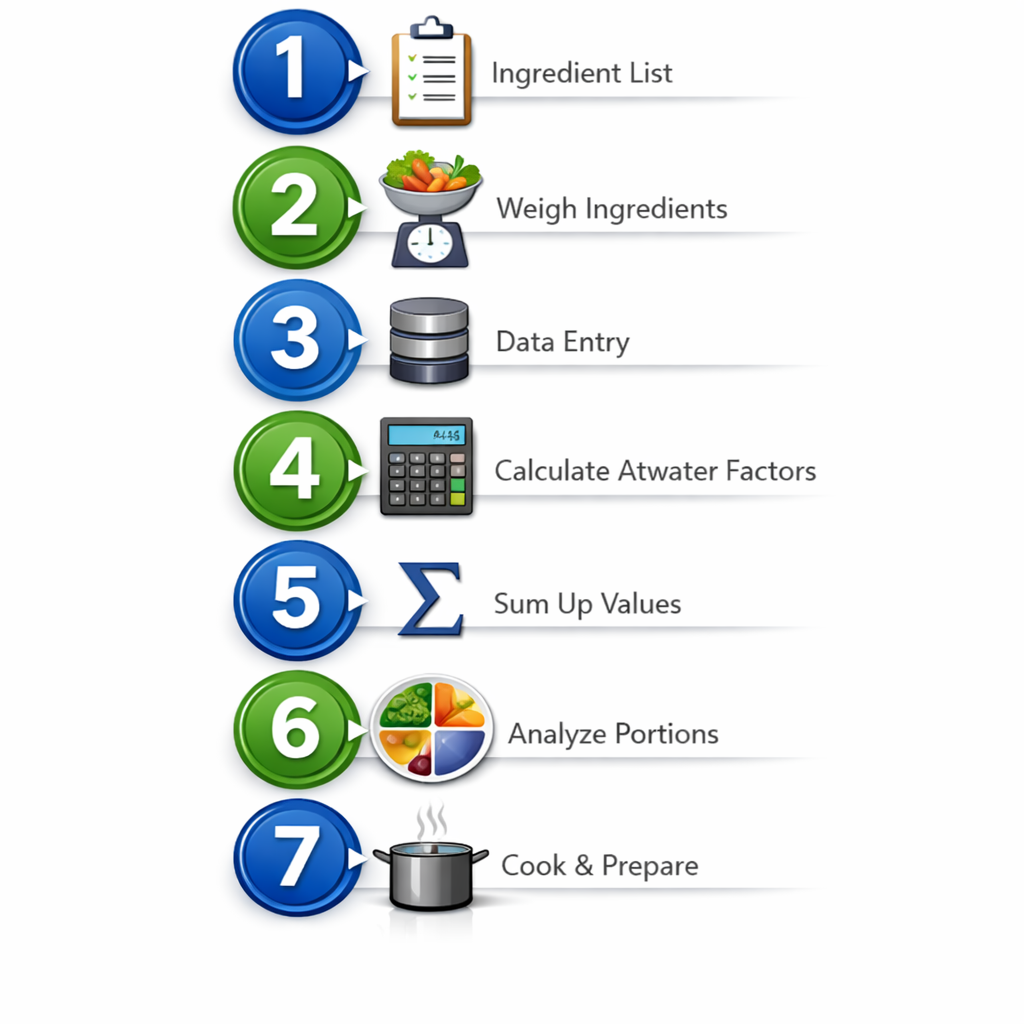
Free nutrition facts calculators have become powerful tools for quick supplement analysis. Here’s how to use them effectively to verify quality claims and assess nutritional adequacy.

Step 1: Gather Complete Product Information
Before using any nutrition facts calculator tool, ensure you have all label information at hand.
Start by documenting everything on the label. Note the product name, manufacturer, lot number, and expiration date. Photograph the Supplement Facts panel clearly. This documentation creates a reference point and enables you to track any discrepancies you discover.
Step 2: Input Serving Size Accurately
Enter the exact serving size as stated on the label. This is crucial because all other calculations depend on this baseline. If the label lists “2 capsules (1,000 mg)” as one serving, that’s your input. Don’t convert or adjust—work with the manufacturer’s declared serving size.
Step 3: Enter Individual Ingredients and Amounts
Input each ingredient with its specific amount per serving. Pay attention to units—some ingredients are measured in milligrams, others in micrograms or International Units (IU). A quality nutrition calculator will help you convert between units when necessary, but starting with accurate label values prevents errors.
Step 4: Review Calculated % DV
The calculator will generate % Daily Value figures based on established nutrient reference values. Compare these percentages to what appears on the product label. Any significant discrepancies warrant further investigation. A variance of a few percentage points might reflect rounding differences, but larger gaps could indicate labeling errors or calculation problems. For manufacturers, our nutritional value calculator guide explains compliance requirements.
Step 5: Cross-Reference with Independent Testing
Use the calculator’s output as a baseline, then search for independent testing results. Organizations like ConsumerLab.com, Labdoor, and others publish testing results showing whether products contain what their labels claim. This external validation confirms whether your calculator-based analysis aligns with laboratory findings.
Step 6: Assess Daily Intake Context
Calculate total daily nutrient intake by adding supplement values to typical dietary consumption. Most nutrition calculators can integrate food sources, giving you a complete picture. For example, if you’re formulating a magnesium supplement, knowing that the average U.S. diet provides 250-350 mg daily helps you determine whether your 200 mg product fills a gap or risks contributing to excess when combined with other sources.
Step 7: Document and Compare
Create a simple spreadsheet tracking your findings. For manufacturers, this documentation becomes part of quality assurance records. For developers evaluating ingredient suppliers, it provides concrete data for comparison. When you analyze multiple products or ingredients using the same methodology, patterns emerge that reveal which suppliers consistently deliver accurate, high-quality materials.
The Bigger Picture: Integrating Supplements with Complete Nutrition
Supplement verification doesn’t happen in isolation. Understanding how supplements fit into total daily nutrient intake separates thorough analysis from superficial label-reading.
Consider a typical scenario: someone takes a multivitamin providing 100% DV of most vitamins, drinks fortified plant milk with added Vitamin D and Calcium, consumes a protein powder with added B-vitamins, and eats meals that naturally contain nutrients. Understanding how whole foods contribute to vitamin intake provides important context. Without careful calculation, it’s easy to unknowingly double or triple certain nutrient intakes while leaving others deficient.
For manufacturers, this reality shapes responsible formulation strategies. Creating products that complement typical dietary patterns rather than overwhelming them demonstrates sophisticated understanding of real-world use cases. A well-designed B-Complex might provide 100-200% DV of B-vitamins, recognizing that water-soluble vitamins are relatively safe at higher levels while still delivering meaningful benefits. Meanwhile, a product containing fat-soluble vitamins might be more conservative, considering accumulation risks.
Interactions between supplements and medications add another layer of complexity. Some supplements affect drug absorption, metabolism, or effectiveness. For example, high-dose calcium supplements can interfere with certain antibiotics, while some botanical ingredients interact with blood thinners. Quality manufacturers provide clear guidance about potential interactions, and this information should factor into your verification process.
When evaluating supplement quality, consider the formulation’s purpose within the broader nutritional context. Does it target a specific deficiency common in the intended population? Does it provide nutrients in forms and amounts that complement rather than compete with dietary sources? These questions reflect the kind of strategic thinking that separates commodity supplements from thoughtfully designed nutritional solutions.
Consulting with healthcare professionals becomes particularly important when supplements are being used therapeutically or by individuals with specific health conditions. A free nutrition calculator provides excellent screening and verification capabilities, but it doesn’t replace professional guidance for complex situations.
Building Quality from the Source: The NutraAeon Approach
True supplement quality begins long before products reach consumers—it starts with ingredient sourcing. At NutraAeon, we’ve built our reputation on understanding that the journey from raw material to finished supplement determines everything that follows.
Our philosophy centers on three interconnected principles: quality, transparency, and empowerment. These aren’t just marketing concepts—they’re operational commitments that shape every partnership and transaction.
Quality means exceeding expectations at every stage. When you source amino acids like L-Theanine for stress relief formulations, you need certainty that purity exceeds 98%, that heavy metal levels fall far below regulatory limits, and that every batch performs consistently. Our testing protocols exceed USP and FDA expectations because we know that your reputation depends on the ingredients you choose. We don’t just meet industry standards—we set them. Learn more about ingredient testing standards that protect your brand.
Transparency transforms the sourcing relationship. Complete documentation, detailed certificates of analysis, and full supply chain visibility from source to delivery give you the confidence to verify every claim you make to your customers. When you work with NutraAeon for ingredients like Magnesium Oxide, Vitamin C in multiple forms, or the complete B-Complex family, you receive not just materials but comprehensive data packages that support your quality assurance processes and regulatory compliance requirements. Explore our complete nutritional ingredient product catalog.
Empowerment comes from partnership, not just transactions. We provide technical expertise, regulatory guidance, and innovative ingredient solutions because we understand the challenges you face. Formulating effective supplements requires more than just combining ingredients—it demands deep knowledge of bioavailability, stability, interactions, and efficacy. Our team brings decades of experience helping manufacturers create products that stand out in competitive markets.
Using free nutrition calculators to verify supplement quality represents an important practice, but it’s most effective when combined with rigorous upstream quality control. When you partner with suppliers who maintain the same commitment to excellence that you bring to your finished products, verification becomes confirmation rather than investigation.
The supplement industry’s future belongs to manufacturers who prioritize transparency, embrace rigorous testing, and build products on foundations of premium ingredients. By understanding how to properly verify supplement quality—through careful label analysis, strategic use of nutrition calculators, recognition of meaningful certifications, and partnerships with quality-focused ingredient suppliers—you position your products for success in an increasingly sophisticated marketplace.
Quality verification isn’t a one-time checklist item. It’s an ongoing commitment that extends from ingredient selection through manufacturing, testing, labeling, and beyond. Every verification step you take strengthens the integrity of your products and reinforces the trust your customers place in your brand. Whether you’re a forward-thinking manufacturer, an enterprise requiring strategic ingredient partnerships, or a nutritional product developer pushing boundaries, your commitment to verified quality sets you apart in an industry where excellence isn’t optional—it’s essential.